
Industry News
EVA vs PUR Edge Banding Glue: Which One Should You Use for Better Bonding?
EVA vs PUR edge banding glue is not just a material comparison. It affects bonding strength, glue line quality, moisture resistance, maintenance workload, rework rate, and long-term production cost. EVA is practical for standard cabinet production, while PUR is usually better for kitchens, bathrooms, premium furniture, and humid markets. This guide helps cabinet shops choose the right adhesive before they blame the edge banding machine, operator, or panel material.
Table of Contents
EVA vs PUR Edge Banding Glue
EVA vs PUR edge banding glue comes down to production priority.
Use EVA when you need lower cost, simple operation, stable daily output, and easy glue pot maintenance. It fits wardrobes, office furniture, standard cabinets, display shelves, and dry indoor furniture.
Use PUR when you need stronger bonding, better moisture resistance, cleaner glue lines, and higher long-term durability. It fits kitchen cabinets, bathroom cabinets, export furniture, premium cabinetry, and projects where edge failure is expensive.
Do not choose edge banding glue by price alone. Match adhesive type with board material, edge band material, production volume, workshop humidity, machine configuration, and maintenance discipline.
What Is EVA Edge Banding Adhesive?
EVA stands for ethylene-vinyl acetate. The Wikipedia article on ethylene-vinyl acetate explains that EVA is a copolymer processed as a thermoplastic material, and some EVA materials are used in hot-melt adhesives.
In edge banding, EVA edge banding adhesive is popular because it is economical, easy to melt, easy to apply, and easy to maintain. It performs well in general furniture production when the machine temperature, feed speed, panel edge, and pressure rollers are properly controlled.
EVA vs PUR edge banding glue is not a “good vs bad” choice. EVA is often the right choice for workshops that need predictable output and lower operating complexity.
However, EVA has limits. In humid environments, high-temperature locations, or premium cabinet projects, the bond can be more vulnerable than PUR. If your shop sees repeated peeling, thick glue lines, or weak bonding after cooling, glue choice may be part of the problem.
What Is PUR Edge Banding Glue?
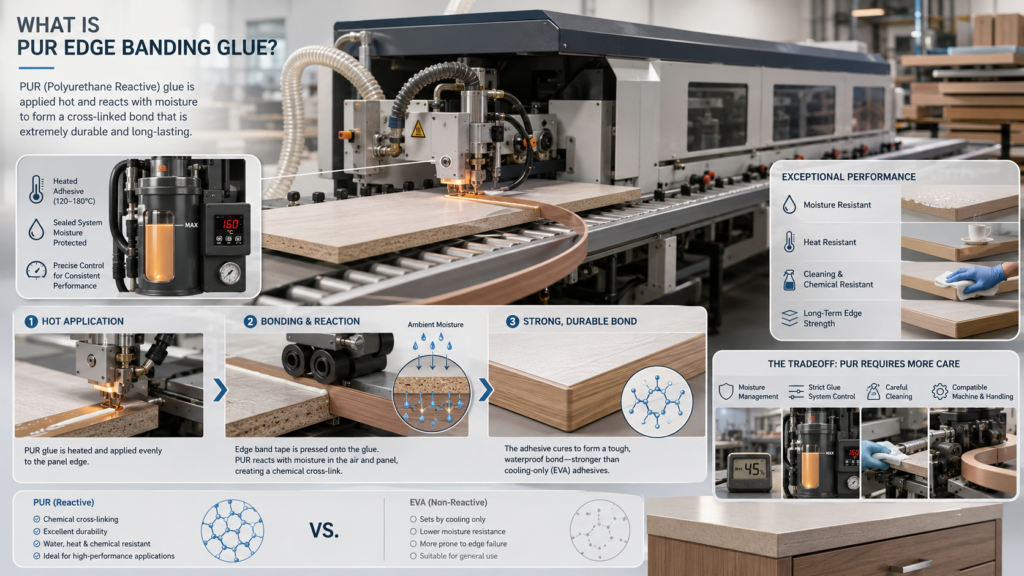
PUR means polyurethane reactive adhesive. The Wikipedia article on polyurethane describes polyurethane as a class of polymers used in many applications, including adhesives and coatings.
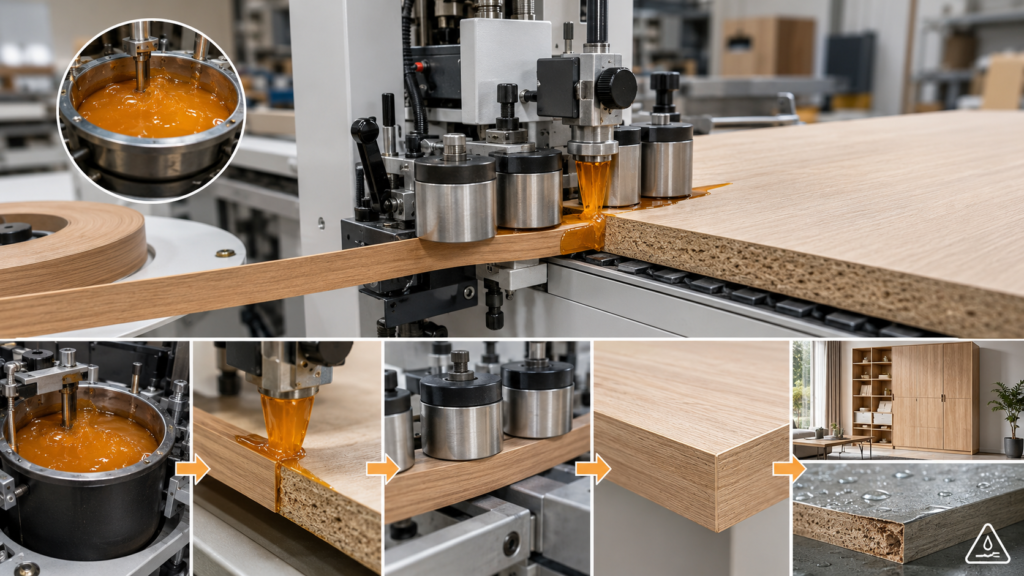
PUR edge banding adhesive is applied hot, but it does more than cool and solidify. It reacts with moisture and forms a stronger cured bond. That is why PUR is often used when the finished cabinet must resist moisture, heat, cleaning exposure, and long-term edge stress.
EVA vs PUR edge banding glue becomes important when a cabinet shop moves from basic furniture to high-value orders. PUR can help reduce peeling and improve edge durability, but it demands better handling.
PUR is not a simple drop-in upgrade for every workshop. It needs stricter glue system control, careful cleaning, moisture management, and machine compatibility. If the glue is left unmanaged, it can cure inside the system and create maintenance issues.
EVA vs PUR Edge Banding Glue: Key Differences That Actually Matter
The table below gives a practical comparison for cabinet production.
| Factor | EVA Glue | PUR Glue |
|---|---|---|
| Initial cost | Lower | Higher |
| Operation difficulty | Easier | More demanding |
| Bonding strength | Good for standard furniture | Stronger after curing |
| Moisture resistance | Moderate | Better |
| Heat resistance | Moderate | Better |
| Glue line appearance | Can be more visible | Often thinner and cleaner |
| Maintenance | Easier glue pot handling | Requires stricter cleaning |
| Best use | Wardrobes, office furniture, standard cabinets | Kitchens, bathrooms, premium furniture |
| Risk if misused | Weak bond, visible glue line | Cured glue blockage, cleaning difficulty |
According to H.B. Fuller’s article on what a hot melt adhesive is, hot melts are solid at room temperature, become liquid when heated, and then build strength as they cool. That explains why temperature stability matters so much in edge banding adhesive performance.
Which Glue Is Better for Kitchen and Bathroom Cabinets?
For kitchen and bathroom cabinets, PUR is usually the better choice. These cabinets face moisture, cleaning chemicals, steam, temperature changes, and frequent daily use. A weak edge bond can lead to swelling, peeling, customer complaints, and rework.
EVA vs PUR edge banding glue should be judged by the final use environment. A dry bedroom wardrobe does not face the same stress as a kitchen base cabinet near a sink.
If you produce standard indoor furniture, EVA may be enough. If your products go into high-humidity spaces, PUR edge banding is usually safer. This is especially true when the customer expects a premium look with a thin, clean seam.
Why Does Edge Banding Glue Fail?
Glue failure usually comes from more than one cause.
Common causes include:
- glue temperature too low or too high
- dusty or rough board edges
- wrong feed speed
- weak pressure roller contact
- edge band material mismatch
- cold panels entering production
- excessive or insufficient glue application
- contaminated glue pot
- wrong adhesive for the environment
EVA vs PUR edge banding glue can influence failure risk, but it does not replace correct setup. If the banding lifts after cooling, review heat, adhesive, pressure, and surface contact. For a step-by-step diagnosis, read our guide to edge banding not sticking.
When the edge looks fine at first but starts separating during handling or later use, compare your case with our guide to edge banding peeling problems.
Does Glue Type Affect Glue Line Quality?
Yes, but glue type is only one part of the result.
EVA glue can create a visible glue line if the glue layer is too thick, the color does not match the panel, or temperature and pressure are not stable. PUR often allows a thinner and cleaner seam, but poor machine setup can still create a bad finish.
Visible glue lines can also come from board edge quality, pre-milling accuracy, trimming, scraping, buffing, and material color. If black seams, thick glue lines, or rough edges are common in your shop, read our guide to edge banding glue line problems.
EVA vs PUR edge banding glue can improve appearance, but the machine still needs stable glue application and proper finishing stations.
EVA or PUR for PVC, Veneer, and ABS Edge Banding?
Different edge materials behave differently.
PVC is common, durable, and practical, but it can show glue lines if temperature, glue amount, or pressure is wrong.
Veneer looks natural but is more sensitive to heat, pressure, trimming, and scraping. It can crack, chip, or show a more obvious seam if the process is not tuned.
ABS and acrylic edge bands may need closer attention to adhesive compatibility, surface finish, and feed speed.
EVA vs PUR edge banding glue should be selected together with the edge material. Glue choice alone cannot fix a wrong material setting. Before production, review our guide to PVC vs veneer edge banding settings.
A research paper on thermoplastic composite hot-melt adhesives notes that hot-melt adhesives are applied in a molten state and become solid as temperature drops. In production, this means the adhesive must wet the surface correctly before it cools.
Does PUR Require More Edge Bander Maintenance?
Yes. PUR usually requires more discipline.
EVA is easier to run in a standard glue pot system. It can be practical for shops that want fewer cleaning steps and simpler daily production.
PUR can deliver stronger performance, but it reacts with moisture. That creates a maintenance risk if operators leave glue inside the system too long or do not follow cleaning procedures.
EVA vs PUR edge banding glue should be considered together with your team’s maintenance ability. If glue pot cleaning is already inconsistent, switching to PUR may increase downtime.
For daily cleaning logic, glue pot care, and clog prevention, use our edge bander maintenance guide before changing adhesive type.
Does PUR Improve ROI or Only Increase Cost?
PUR has a higher adhesive cost, but ROI is not only about glue price.
If PUR reduces peeling, warranty claims, returned cabinets, rework, and premium cabinet rejection, it may save money in the right production environment. On the other hand, if your shop mainly produces standard dry indoor furniture, EVA may deliver a better cost-performance balance.
EVA vs PUR edge banding glue should be judged by total production cost:
1.adhesive cost
2.glue consumption
3.rework rate
4.labor time
5.maintenance downtime
6.customer complaints
7.product selling price
8.xpected service environment
For a wider production cost view, compare adhesive decisions with your automatic edge bander ROI calculation.
Do You Need a PUR-Compatible Edge Banding Machine?
If your workshop plans to use PUR regularly, machine configuration matters.
Look for stable glue temperature control, reliable glue application, strong pressure rollers, easy cleaning access, and enough trimming, scraping, and buffing precision to support premium cabinet production.
EVA vs PUR edge banding glue is not only about the glue bag. It is also about whether the machine can control the process. A weak glue system, unstable feed, poor pressure, or dirty glue pot can make even good adhesive perform badly.
If you are still comparing automation levels, production capacity, and machine functions, start with our automatic edge banding machine guide.
Woodworking Network’s article on choosing an edgebander also explains that most edgebanders use hot-melt glue, and that EVA is common for affordability and ease of use while PUR is a premium option with stronger water-resistant performance.
EVA vs PUR Edge Banding Glue Selection Checklist
Use this checklist before choosing adhesive:
- Is the furniture used in a dry or humid environment?
- Is the product standard furniture or premium cabinetry?
- Is the edge band PVC, ABS, veneer, acrylic, or PET?
- Is a thin glue line important for the customer?
- Can your machine hold glue temperature steadily?
- Can your operators clean and maintain the glue system correctly?
- Is peeling a repeated complaint?
- Is rework costing more than the adhesive upgrade?
- Does the shop run short batches or long production shifts?
- Can the current machine support PUR safely and efficiently?
EVA vs PUR edge banding glue should be selected after answering these questions, not after a defect appears on finished cabinets.
Conclusion
EVA vs PUR edge banding glue should be chosen by production reality, not by trend. EVA is still practical for standard cabinet production, lower cost control, and simpler maintenance. PUR is better when the project needs moisture resistance, stronger bonding, cleaner seams, and premium durability. The best result comes from matching adhesive, panel material, edge band type, machine settings, pressure, maintenance, and ROI. If your workshop wants better bonding, fewer peeling complaints, and more stable cabinet quality, treat EVA vs PUR edge banding glue as a process decision, not just a glue purchase.
FAQ
Is PUR always better than EVA for edge banding?
No. PUR is stronger and more moisture-resistant, but EVA is cheaper, easier to use, and suitable for many standard cabinet jobs.
Which glue is better for kitchen cabinets?
PUR is usually better for kitchen cabinets because they face moisture, heat, cleaning exposure, and long-term edge stress.
Why does EVA edge banding peel off?
Common causes include low glue temperature, dusty board edges, weak pressure, fast feed speed, cold materials, or poor adhesive compatibility.
Does PUR reduce visible glue lines?
PUR can help create thinner and cleaner seams, but glue line quality still depends on temperature, pressure, board edge quality, trimming, scraping, and buffing.
Can one edge banding machine use both EVA and PUR?
Some machines can support both, but not all. Check the glue system, cleaning process, temperature control, and supplier configuration.