
Industry News
Edge Banding Material Settings: PVC vs Veneer Without Wasted Panels
Switching Edge Banding Material sounds simple until the first batch starts showing glue overflow, veneer cracks, rough trimming, visible glue lines, or rejected cabinet panels. In real furniture production, PVC and wood veneer do not behave the same under heat, pressure, trimming, scraping, and feed speed.
This guide explains how to adjust your edge banding machine when moving between thick PVC and thin veneer, how to reduce waste during material changeover, and why machine compatibility matters for factories producing mixed cabinet and furniture designs.
Table of Contents
Why Changing Edge Banding Material Often Increases Waste
When operators change Edge Banding Material but keep the same machine settings, defects are almost guaranteed. PVC may need firmer pressure and clean trimming support, while veneer needs gentler handling because it is thinner, more natural, and more sensitive to cracking or pressure marks.
Wood veneer is different. It behaves more like a natural surface layer than a plastic strip. Grain direction, moisture, adhesive behavior, and cutting sharpness all influence final edge quality.
That is why the first question should not be “Which material is better?”
It should be: “Are the machine settings matched to the material?”
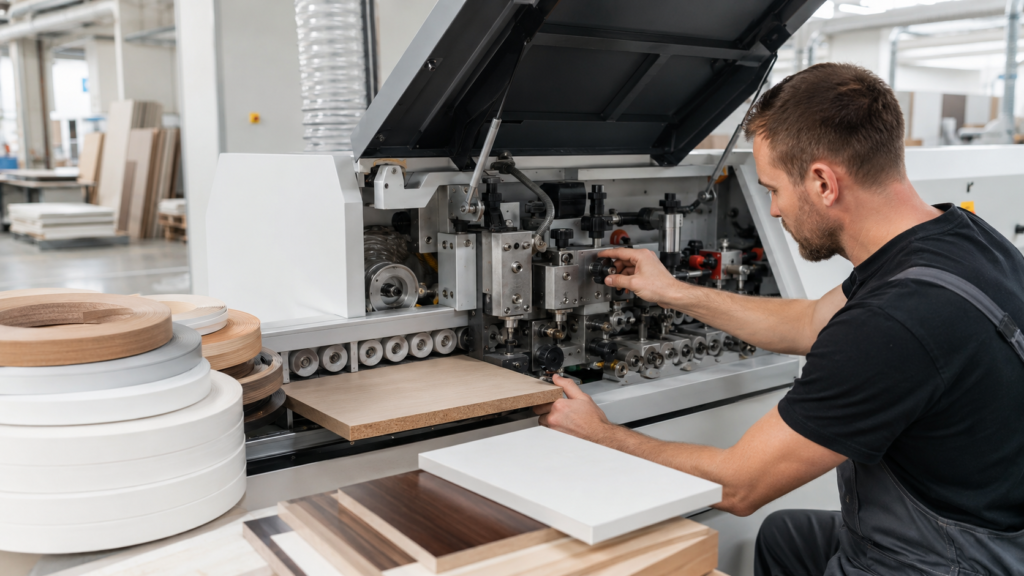
Veneer vs PVC Banding: What Changes in Real Production?
Veneer vs PVC banding is not just an appearance decision. It changes the way the machine should feed, glue, press, trim, scrape, and polish the edge.
| Factor | PVC Edge Banding | Wood Veneer Edge Banding |
|---|---|---|
| Material behavior | Flexible, plastic-based, consistent | Thin, natural, grain-sensitive |
| Common thickness | Often thicker | Often thinner |
| Glue response | Needs stable heat and pressure | Sensitive to overheating and pressure marks |
| Trimming | Needs strong, clean cutting | Needs sharp and gentle trimming |
| Common risk | Glue overflow, rough trimming, edge bulging | Cracking, burn marks, visible glue line |
Each Edge Banding Material creates different pressure and trimming requirements. If operators treat veneer like PVC, cracks and surface marks may appear. If they treat thick PVC like veneer, the strip may not bond tightly or trim cleanly.
Adjusting Edge Banding Machine Settings for Thick PVC and Thin Veneer
Adjusting edge banding machine settings for thick PVC and thin veneer starts with three areas: glue, pressure, and trimming.
For thick PVC edge banding:
- Check that glue temperature is stable before production.
- Use enough pressure to bond the thicker strip tightly.
- Confirm the trimming unit is sharp and correctly aligned.
- Adjust scraping to remove excess edge without gouging.
- Use dust collection to keep chips from affecting the finish.
For thin wood veneer edge banding:
- Avoid excessive pressure that can crush or mark the surface.
- Use sharp cutters to prevent tearing along the grain.
- Watch for overheating, especially near the glue line.
- Keep feed speed stable to avoid inconsistent bonding.
- Test small batches before full production.
Edge Banding Material changes should always begin with trial pieces. A short test run can save dozens of rejected panels later.
Feed Speed, Glue Temperature, and Pressure Come First
Feed speed, glue temperature, and pressure are usually the first settings operators should check. These three settings affect almost every downstream result.
Each Edge Banding Material reacts differently:
- If feed speed is too fast, glue may not bond evenly.
- If feed speed is too slow, veneer may overheat.
- If glue is too cold, the strip may peel.
- If glue is excessive, the glue line becomes visible.
- If pressure is too low, PVC may lift.
- If pressure is too high, veneer may dent or crack.
Pro Tip: Do not adjust five settings at once. Change one variable, inspect the edge, then continue. This makes it easier to identify the real cause of defects.
How to Reduce Waste When Switching Edge Banding Materials
Edge Banding Material changeover should follow a repeatable process. Many factories lose panels because they rely on operator memory instead of documented settings.
A practical changeover workflow:
1.Confirm strip thickness and width.
2.Check panel edge quality after pre-milling.
3.Warm up the glue system properly.
4.Run one or two short test panels.
5.Inspect glue line, edge tightness, and trimming quality.
6.Adjust pressure rollers gradually.
7.Fine-tune trimming, scraping, and buffing.
8.Record the final settings for that material.
Good factories build a material setting record. This is especially useful when switching between PVC edge banding, wood veneer edge banding, ABS, melamine, or solid wood strips.
How to Prevent Veneer Edge Banding Cracks
Thin veneer Edge Banding Material is more sensitive than PVC. It can crack because of poor moisture balance, dull trimming tools, excessive pressure, grain direction, or overheating near the glue line.
To reduce veneer cracks:
- Keep cutters sharp.
- Avoid excessive pressure on the pressure wheels.
- Check veneer storage conditions.
- Reduce aggressive scraping.
- Control glue temperature carefully.
- Inspect grain direction and veneer quality before feeding.
Veneer looks premium when it is handled well, but it is less forgiving than PVC. For high-end cabinet doors and decorative furniture panels, a small crack can make the edge look unacceptable.
How to Trim Thick PVC Edge Banding Cleanly
Thick PVC Edge Banding Material usually creates a different problem: it may bond well but trim poorly. Rough trimming, white stress marks, glue overflow, and edge bulging often appear when the cutting unit or pressure setting is not matched to the strip.
To improve thick PVC edge quality:
- Make sure pre-milling leaves the board edge straight.
- Check trimming knives before large batches.
- Adjust scraping depth carefully.
- Use buffing to remove fine tool marks.
- Keep the pressure beam stable.
- Remove chips and dust before they affect polishing.
PVC is consistent and efficient, but it still needs correct machine calibration.
Why Machine Compatibility Matters for Mixed-Material Production
Factories that process more than one Edge Banding Material need more than a basic machine. They need stable feeding, adjustable pressure, accurate trimming, reliable glue control, and good dust collection.
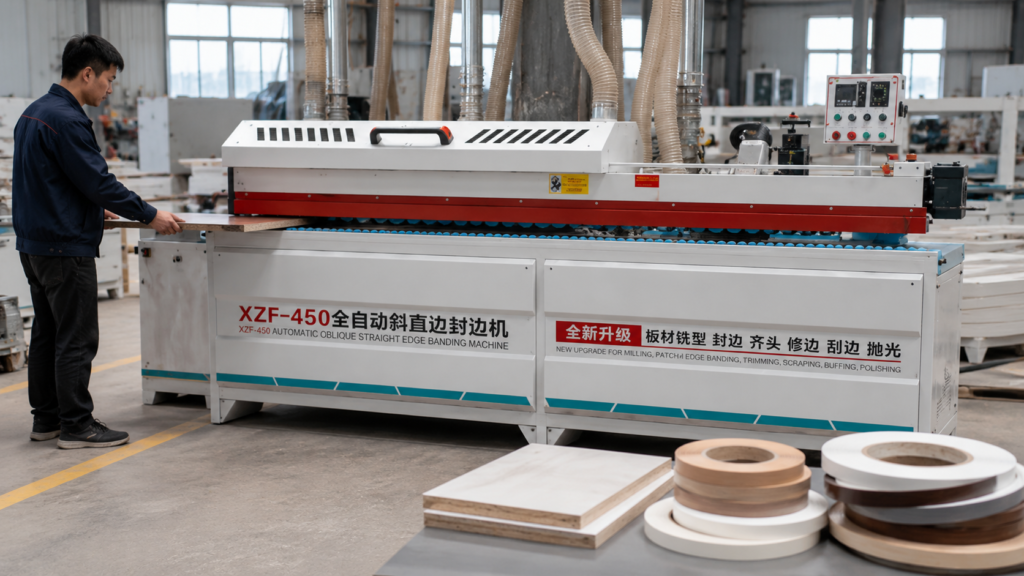
This is where the equipment choice becomes part of quality control. XZF-450 Full-Automatic Bevel and Straight Edge Banding machine is designed for straight and bevel edge banding, with features such as automatic pressure beam, flexible angle adjustment, pre-milling, contoured pressure wheel, and dual dust collection.
For workshops switching between PVC and wood veneer, this kind of flexibility matters. A machine that supports stable adjustment can help operators reduce trial waste, keep glue lines cleaner, and maintain edge quality across different panel designs.
This is not about buying a machine for one material. It is about choosing equipment that supports real production variation.
Edge Banding Machine Settings That Operators Should Record
For every Edge Banding Material, operators should record the settings that produced a stable result.
Useful records include:
- Material type
- Strip thickness
- Strip width
- Glue type
- Glue temperature
- Feed speed
- Pressure roller setting
- Trimming adjustment
- Scraping depth
- Buffing condition
- Panel material
- Defect notes
How to Judge Whether the Settings Are Correct
Before full production, inspect several panels from different angles. Do not only check whether the strip is attached.
Look for:
- Consistent glue line
- No visible gaps
- No veneer cracks
- No PVC edge bulging
- Clean top and bottom trimming
- Smooth corner finish
- No burn marks
- No pressure dents
- No dust trapped in the finish
If one Edge Banding Material looks good and another does not, the issue may not be the machine itself. It may be that the machine was never reset for the new material.
Buying Considerations for Furniture Factories
Before choosing Edge Banding Material or equipment, factories should consider both appearance and production stability.
Ask these questions:
- Will the factory process only PVC, or also veneer?
- Are panels straight edge, bevel edge, or both?
- How often does material changeover happen?
- Is waste caused by glue, trimming, or pressure?
- Does the machine support stable feed speed adjustment?
- Are pressure rollers easy to set?
- Does the machine include pre-milling and dust collection?
- Can operators record repeatable settings?
A practical machine should help reduce operator guesswork. That is especially important for cabinet factories, custom furniture workshops, and production teams handling mixed materials.
Conclusion
Edge Banding Material decisions should not stop at color, cost, or thickness. In real production, PVC and veneer require different glue behavior, pressure, feed speed, trimming, scraping, and finishing control.
The right Edge Banding Material settings help reduce waste, improve glue lines, and keep cabinet edges consistent. For factories switching between PVC and wood veneer, a compatible automatic edge banding machine can make the changeover process more predictable and less dependent on guesswork.
FAQ
What is the best edge banding material for cabinets?
PVC is common for durability and cost control. Wood veneer is better when natural wood appearance and premium surface style matter.
Is PVC edge banding easier to process than veneer?
Usually yes. PVC is more consistent, while veneer is thinner and more sensitive to heat, pressure, cutting quality, and cracking.
Why does edge banding fail after switching materials?
Most failures happen because glue temperature, feed speed, pressure, trimming, or scraping settings were not adjusted for the new material.
How do I reduce waste when changing edge banding materials?
Run test pieces, inspect the glue line, adjust pressure and trimming, then record successful settings for each material type.
What causes visible glue lines in edge banding?
Visible glue lines can come from excessive glue, unstable temperature, insufficient pressure, poor edge preparation, or mismatch between strip and panel color.