
Actualités de l'industrie
Which Edge Bander Features Actually Improve Finished Panel Quality?
Edge bander features should be judged by one result: the finished panel that leaves the machine. A bigger automatic edge bander is not always better, and more functions do not always mean better cabinets. This guide explains which functions actually improve edge quality, where buyers should invest first, and how pre-milling, gluing, pressure rollers, trimming, scraping, buffing, and corner rounding change panel furniture production.
Table des matières
Which Edge Bander Features Improve Panel Quality the Most?
The most valuable edge bander features are the ones that remove visible defects or prevent bonding failure. For most cabinet and panel furniture factories, the priority is not the longest function list. The priority is a stable finishing chain.
If you are still comparing basic machine types, start with this automatic edge banding guide before choosing individual functions.
A practical ranking looks like this:
| Fonction | What It Improves | Quality Impact | Worth Paying For? |
|---|---|---|---|
| Pre-milling | Chips, saw marks, uneven board edge | Very high | Yes, for visible panels |
| Système de colle | Bonding strength and glue line | Very high | Yes |
| Pressure rollers | Adhesive contact and edge stability | Very high | Yes |
| End trimming | Front and rear edge accuracy | Haut | Yes |
| Fine trimming | Top and bottom edge smoothness | Haut | Yes |
| Grattage | Cutter marks, glue residue, micro lines | Very high | Yes for premium cabinets |
| Buffage | Final surface polish | Medium-high | Yes for visible edges |
| Corner rounding | Door and drawer corner finish | Medium-high | Depends on product type |
The key idea is simple: finished panel quality is created by a chain. If one step is weak, the next function may not fully fix the problem.
Do You Need Pre-Milling on an Edge Bander?
Pre-milling is one of the edge bander features that directly affects the first contact between board and edge tape. It cuts a small amount from the panel edge before glue is applied. This helps remove saw marks, tiny chips, dust-burned edges, and small uneven areas.
Without pre-milling, the glue system may still work, but it is bonding to a weaker edge surface. That can create visible glue lines, weak contact, or rough finished edges.
Pre-milling is especially useful when:
- panels come from different cutting machines
- MDF or particleboard edges chip easily
- white or light-colored cabinets show every seam
- the factory wants higher consistency at speed
- the final product is visible to end customers
Why Glue Application Still Decides the Final Edge
Glue application is one of the edge bander features buyers should never treat as a small detail. Even perfect trimming cannot save a panel if the glue layer is uneven or the pressure rollers do not create firm contact.
Hot melt adhesive performance depends on heat, wetting, open time, pressure, and cooling. H.B. Fuller’s article on what a hot melt adhesive is explains that hot melts are solid at room temperature, become liquid when heated, and build strength after cooling. In edge banding, that means glue temperature and timing matter.
Buyers should check:
1.glue pot stability
2.glue roller accuracy
3.EVA or PUR compatibility
4.temperature control
5.pressure roller alignment
6.cleaning access
7.glue amount adjustment
If you are comparing adhesive types, this guide on EVA vs PUR edge banding glue can help match glue choice with cabinet use, moisture exposure, and bonding requirements.
Woodworking Network’s article on zero-joint edgebanding and adhesive options also notes that EVA, PUR, pre-coated, glue-layer, and zero-joint systems are all used in the market. That is why the best glue system depends on your product, not only machine price.
Why Do Black Glue Lines Still Appear?
Black seams usually happen when the edge, glue, pressure, trimming, or scraping process is not controlled well. This is where edge bander features must work together.
Les causes courantes comprennent :
- too much or too little glue
- unstable glue temperature
- poor panel edge preparation
- wrong edge tape color or thickness
- weak pressure roller contact
- dirty glue pot
- inaccurate scraping
- mismatched material settings
If black seams are common in your shop, review these edge banding glue line problems before blaming the whole machine.
This is also where pressure rollers matter. A glue system applies adhesive, but pressure rollers make the bond. Weak pressure can leave gaps even when the adhesive looks correct.
Do Trimming, Scraping, and Buffing Functions Matter?
Yes. These edge bander features decide whether the panel looks truly finished or only covered.
End trimming cuts the front and rear ends of the edge tape. Rough trimming removes extra material from the top and bottom. Fine trimming creates a smoother profile. Scraping removes small cutter marks or glue residue. Buffing gives the final edge a cleaner look.
For shops focused on integrated finishing, this edge banding trimming machine guide explains how trimming and finishing stations work together.
The difference is easy to see:
| Finished Panel Problem | Function to Check |
|---|---|
| Long edge tape at panel ends | End trimming |
| Rough top or bottom edge | Fine trimming |
| Cutter marks on PVC edge | Grattage |
| Glue residue near seam | Scraping and cleaning |
| Dull or dirty edge surface | Buffage |
| Uneven finish at high speed | Feeding, tracking, and tool condition |
A woodworking edge bander with better trimming and finishing functions can reduce manual sanding and rework. That is why these functions are not cosmetic extras for premium cabinet work.
Do I Need Corner Rounding on an Edge Bander?
The long-tail answer to “do I need corner rounding on an edge bander” depends on the product.
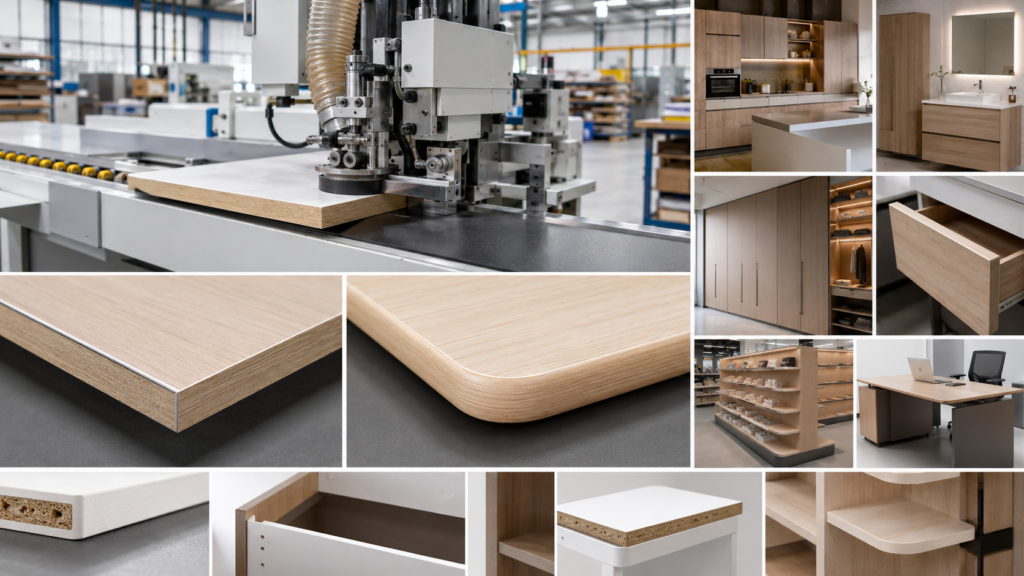
Corner rounding is valuable when the finished panel has visible front corners, such as cabinet doors, drawers, shelves, and premium furniture parts. It makes the edge feel smoother and look more complete. It also reduces the sharp, unfinished look that appears when straight trimming leaves square tape corners.
You may need corner rounding if you produce:
- kitchen cabinet doors
- bathroom cabinets
- wardrobes
- drawers
- retail fixtures
- premium office furniture
- exposed shelves
You may not need it at the beginning if your shop only processes hidden parts, low-end panels, or simple straight edges where cost matters more than appearance.
This is one of the edge bander features that should be decided by product style, not by sales pressure.
How Do Materials Change the Features You Need?
PVC, ABS, veneer, acrylic, melamine, and solid wood strips do not behave the same. Material choice changes glue temperature, trimming pressure, scraping depth, buffing needs, and corner finishing.
Woodworking Network’s guide on choosing an edgebander explains that common edge strips include PVC, ABS, and wood veneer, with thicknesses ranging from thin tape to thicker impact-resistant edges. That means buyers should check whether the machine can handle the materials they actually use.
For a practical production view, review this guide to edge banding material settings before choosing machine functions.
Basic material logic:
| Matériel | What to Watch |
|---|---|
| PVC | Glue line, trimming marks, scraping accuracy |
| Veneer | Heat sensitivity, chipping, sanding need |
| ABS | Clean trimming and adhesive compatibility |
| Acrylique | Surface protection and polishing |
| Thick edge tape | Corner rounding and stronger trimming |
| Thin tape | Glue control and pressure stability |
The best edge bander features for one shop may be unnecessary for another because their materials and finished products are different.
Which Features Fix Common Edge Banding Defects?
A buyer can also choose functions by working backward from defects. This is often more useful than reading a machine brochure.
| Defect | Cause probable | Function to Check |
|---|---|---|
| Peeling edge band | Weak glue contact or wrong adhesive | Glue system, pressure rollers |
| Black glue line | Glue amount, color mismatch, poor scraping | Glue control, scraping |
| Chipped panel edge | Poor cutting before banding | Pre-milling |
| Rough top or bottom edge | Inaccurate trimming | Fine trimming |
| Sharp exposed corners | No corner finishing | Corner rounding |
| Dirty edge surface | Glue residue or dust | Buffing and cleaning |
| Inconsistent quality at speed | Weak feeding or tool wear | Tracking, maintenance, tooling |
When defects like peeling, glue lines, or poor bonding appear, this guide to edge banding problems and fixes can help identify the real cause.
This defect-first method is useful because it connects machine configuration with finished panel quality. It also prevents buyers from paying for functions that do not solve their main problem.
Which Edge Bander Features Are Worth Paying For?
This is where edge bander features should be reviewed as a cost-quality decision, not as a decoration list.
Not every extra function is worth paying for in every factory. The right question is: does the function reduce rework, protect visible quality, save labor, or improve production consistency?
For standard cabinet shops, stable gluing, pressure rollers, end trimming, fine trimming, and buffing may already solve most daily needs.
For mid-size panel furniture production, pre-milling, scraping, better feeding, and more stable trimming become more important.
For premium cabinet producers, PUR glue, scraping, buffing, and corner rounding can protect the final appearance.
For high-volume production, tracking accuracy, speed stability, dust control, quick adjustment, and maintenance access become part of quality control.
If you are calculating whether extra functions justify the cost, compare the decision with your automatic edge bander ROI.
A simple buying rule works well:
- If the feature reduces visible defects, consider it seriously.
- If it only adds convenience, compare it with labor cost.
- If your product does not need that finish, do not overpay.
- If the feature reduces rework every day, it may pay back faster than expected.
Can Maintenance Affect Finished Panel Quality?
Yes. Even the right edge bander features will fail if the machine is dirty, misaligned, or running with worn tools.
OSHA’s page on woodworking hazards and solutions notes that woodworking operations involve machine hazards and health hazards such as wood dust and finishing chemicals. In edge banding, dust and chips can also affect glue application, trimming accuracy, and buffing results.
Maintenance should include:
1.cleaning the glue pot
2.checking glue roller condition
3.removing adhesive residue
4.checking trimming cutters
5.cleaning buffing wheels
6.confirming pressure roller alignment
7.checking dust extraction
8.recording settings for each material
A clean machine is not only a safety issue. It is a quality issue. If glue residue, dust, or worn cutters remain in the system, the finished panel will show it.
What Should Buyers Check Before Choosing an Automatic Edge Bander?
Before buying an automatic edge bander, buyers should match the machine to the finished product.
Use this checklist:
1.What panel material do you process most?
2.Do your panels show chips after cutting?
3.Do you use PVC, veneer, ABS, acrylic, or thick edge tape?
4.Is the final edge visible to customers?
5.Do you need EVA, PUR, or both?
6.Do you need pre-milling?
7.Do you need corner rounding?
8.Is manual sanding slowing delivery?
9.Are black glue lines a current complaint?
10.How many panels do you process per shift?
11.Can operators clean and maintain the machine correctly?
12.Which functions will reduce rework, not just add price?
This checklist turns edge bander features into a purchasing decision, not a feature race.
Conclusion
Edge bander features should be selected by finished panel quality, not by the length of the machine configuration list. Pre-milling prepares the board edge, glue application and pressure rollers decide bonding, trimming shapes the tape, scraping removes cutter marks, buffing improves the final look, and corner rounding upgrades visible parts. The right automatic edge bander should match your materials, factory size, product quality level, and ROI target. When buyers connect each function with a real defect or quality goal, edge bander features become a practical investment decision instead of a confusing sales checklist.
FAQ
Which edge bander features improve panel quality the most?
Pre-milling, stable glue application, pressure rollers, fine trimming, scraping, buffing, and corner rounding usually have the strongest impact on finished panel quality.
Do I need pre-milling on an edge bander?
Yes, if your panel edges often show saw marks, chips, or uneven cutting. Pre-milling helps create a cleaner edge before glue is applied.
What does scraping do on an edge bander?
Scraping removes small cutter marks, glue residue, and micro lines after trimming. It helps the edge look smoother and more professional.
Does buffing improve edge banding quality?
Yes. Buffing helps clean and polish the finished edge, especially on visible cabinet panels and glossy edge materials.
Do I need corner rounding on an edge bander?
You need corner rounding if you produce cabinet doors, drawers, shelves, or visible furniture parts where smooth corners improve appearance and touch.