
Noticias de la industria
Do Edge Banding Materials Affect Edge Bander Selection?
Edge banding materials affect more than the look of a cabinet edge. They can change glue choice, temperature, feed speed, pressure, trimming tools, scraping depth, buffing needs, and even which edge bander configuration makes sense. This guide helps buyers compare PVC edge banding, ABS edge banding, wood veneer edge banding, acrylic, high-gloss bands, and thicker tapes before choosing an automatic edge bander.
Tabla de contenido
Do Edge Banding Materials Really Affect Edge Bander Selection?
Yes. Edge banding materials directly affect edge bander selection because each material behaves differently under heat, pressure, cutting, scraping, and polishing.
A basic machine may handle simple PVC tape well. But a shop that processes ABS, veneer, acrylic, high-gloss bands, and thick edge tape needs better temperature control, sharper trimming, more stable pressure, cleaner scraping, and stronger finishing functions.
Woodworking Network’s article on choosing an edgebander explains that edgebanding strips include PVC, ABS, and wood veneer, with thicknesses ranging from thin tape to thicker impact-resistant edges. That is the first reason buyers should not choose a machine before checking the material mix.
If you are still deciding which machine functions matter most, this guide to edge bander features explains how pre-milling, gluing, trimming, scraping, buffing, and corner rounding affect finished panel quality.
PVC vs ABS Edge Banding: What Changes in Machine Settings?
PVC vs ABS edge banding is one of the most common comparisons in cabinet production.
PVC edge banding is widely used because it is flexible, available in many colors and woodgrain patterns, and practical for standard cabinet production. The Wikipedia page on polyvinyl chloride explains that PVC is a commonly used synthetic polymer.
ABS edge banding is often selected when buyers want a tougher plastic banding option with good impact resistance and cleaner environmental positioning. The Wikipedia page on ABS plastic describes ABS as a thermoplastic polymer commonly used for its toughness and impact resistance.
For machine setup, the difference is practical:
| Material | Machine Concern | What Buyers Should Check |
|---|---|---|
| PVC edge banding | Glue line, trimming marks, scraping | Stable glue amount, sharp cutters, scraper adjustment |
| ABS edge banding | Adhesive compatibility, clean trimming | Temperature stability, cutter quality, edge pressure |
| Thick PVC or ABS | Cutting load and corner finish | Strong trimming, corner rounding, pressure rollers |
| Thin tape | Glue control and feeding | Accurate glue roller, steady feed speed |
Edge banding materials do not require a completely different machine every time, but they often require different settings and better control.
Is Wood Veneer Edge Banding Harder to Process?
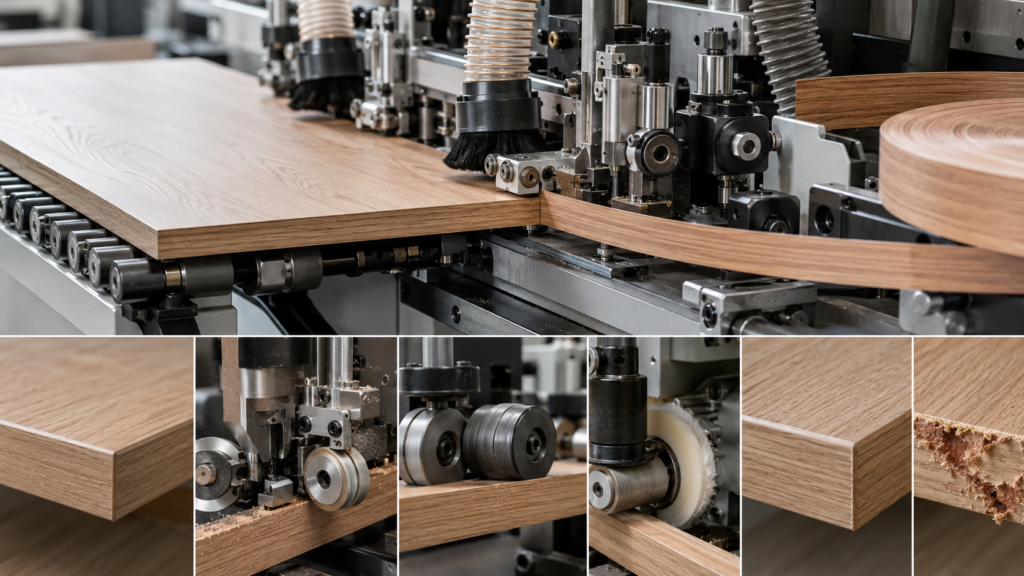
Wood veneer edge banding is different from plastic tape. It gives furniture a natural wood look, but it is also more sensitive to heat, pressure, grain direction, tool sharpness, and sanding.
The Wikipedia article on wood veneer explains that veneer is made from thin slices of wood, often bonded onto core panels for furniture and interior applications. That thin natural layer is why veneer can look premium but also needs careful handling.
For veneer, buyers should focus on:
- sharp trimming tools
- gentle pressure control
- stable feed speed
- dust extraction
- controlled glue application
- careful scraping or sanding
- clean board edge preparation
Wood veneer edge banding can expose weak machine setup faster than standard PVC. Dull cutters may tear the grain. Excess heat may damage the surface. Too much scraping can leave visible marks.
This is where edge banding materials influence both machine configuration and operator discipline.
Do Acrylic and High-Gloss Edge Bands Need Better Finishing?
Yes. Acrylic and high-gloss edge bands are appearance-driven materials. They are used when the final panel must look clean, modern, and premium.
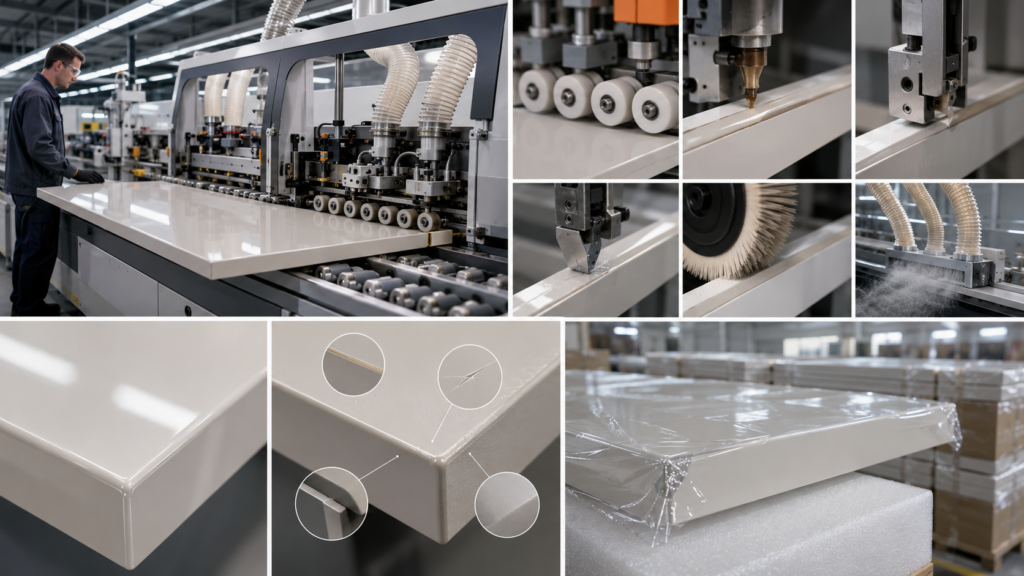
These materials make defects easier to see. A small glue line, scratch, trimming mark, or dull edge can stand out under showroom lighting.
Buyers using acrylic or high-gloss bands should pay attention to:
1.clean pressure roller contact
2.stable glue application
3.accurate trimming
4.light and controlled scraping
5.buffing quality
6.surface protection before and after processing
7.dust control around the finishing area
The machine does not only need to attach the tape. It needs to finish the edge without damaging the surface.
For premium cabinets, edge banding materials like acrylic and high-gloss bands often justify better scraping and buffing functions.
How Edge Banding Materials Change Machine Settings
The long-tail question “how edge banding material affects machine settings” is important because many defects come from using one setting for every material.
| Setting | Why It Changes |
|---|---|
| Temperatura del pegamento | Different adhesives and materials need stable heat control |
| Glue amount | Thin tape and light colors show glue lines faster |
| Velocidad de alimentación | Veneer and glossy materials may need more controlled processing |
| Pressure rollers | Thick bands and rigid materials need firm contact |
| Trimming cutters | PVC, ABS, veneer, and thick bands cut differently |
| Profundidad de raspado | Too deep can damage plastic or veneer surfaces |
| Buffing wheels | Glossy and visible edges need cleaner finishing |
| Corner rounding | Thick tape, doors, drawers, and visible shelves benefit more |
H.B. Fuller’s article on hot melt adhesives explains that hot melts become liquid when heated and build strength as they cool. In edge banding, that means temperature, open time, pressure, and cooling all affect the final bond.
If your shop changes between EVA and PUR, this guide to EVA vs PUR edge banding glue can help connect glue choice with moisture resistance, bonding strength, and maintenance requirements.
Which Edge Banding Materials Expose Machine Problems Faster?
Some materials are more forgiving. Others show every mistake.
PVC edge banding often exposes glue line problems, scraper marks, and poor buffing. ABS edge banding can expose poor trimming or adhesive mismatch. Wood veneer edge banding exposes dull tools, tearing, excess pressure, and dust problems. Acrylic and high-gloss bands expose scratches, visible seams, and weak polishing.
A simple defect guide can help:
| Finished Problem | Material Where It Appears Fast | Machine Area to Check |
|---|---|---|
| Black glue line | Light PVC, high-gloss bands | Glue amount, pressure, scraping |
| Torn edge | Wood veneer | Cutter sharpness, feed speed |
| Chipped corner | Thick PVC or ABS | End trimming, corner rounding |
| Dull finished edge | Acrylic, high-gloss | Buffing and surface protection |
| Peeling | All materials | Glue, pressure, temperature |
| Visible cutter marks | PVC, ABS, acrylic | Fine trimming and scraping |
If the finished panel shows black seams, this guide to edge banding glue line problems explains why the seam can look cheap even when the machine is running.
What Is the Best Edge Banding Material for Cabinets?
There is no single best material for every cabinet. The best edge banding material for cabinets depends on appearance, cost, durability, moisture exposure, production volume, and the machine’s ability to process the band cleanly.
A practical answer looks like this:
| Cabinet Type | Common Choice | Por qué |
|---|---|---|
| Standard kitchen cabinets | PVC edge banding | Cost-effective and widely available |
| Higher-end cabinets | ABS edge banding or acrylic | Cleaner appearance and stronger visual appeal |
| Natural wood furniture | Wood veneer edge banding | Matches wood surface and premium design |
| Modern glossy panels | Acrylic or high-gloss bands | Better visual match with glossy boards |
| Durable commercial furniture | Thick PVC or ABS | Better impact resistance |
| Custom furniture | Mixed materials | Requires flexible edge bander settings |
Edge banding materials should be selected with the panel, glue, machine, and final use environment together. A premium edge tape will not look premium if the machine cannot trim, scrape, and buff it cleanly.
How Should Materials Guide Edge Bander Selection?
Edge bander selection should start with the product, not the catalog.
Ask what your factory actually processes every week. A small cabinet shop using mostly PVC may not need the same configuration as a premium shop using veneer, acrylic, and thick ABS.
A useful buying map looks like this:
| Factory Type | Common Materials | Machine Focus |
|---|---|---|
| Small cabinet shop | PVC, melamine edge tape | Stable gluing, trimming, buffing |
| Mid-size panel furniture factory | PVC and ABS | Pre-milling, scraping, stable feed |
| Premium cabinet producer | ABS, acrylic, high-gloss | Fine trimming, scraping, buffing, corner rounding |
| Veneer furniture workshop | Wood veneer | Sharp cutters, gentle pressure, dust control |
| High-volume production line | Mixed edge banding materials | Automatic adjustment, stable speed, maintenance access |
This is where edge bander selection becomes a quality decision. The machine should match the edge tape, panel type, glue system, and finished panel standard.
If your shop handles many materials, this article on edge banding material settings gives a practical setup view for PVC and veneer without wasting panels.
Do Different Materials Require Different Glue Choices?
Often, yes. The material itself does not decide everything, but it affects adhesive choice and process control.
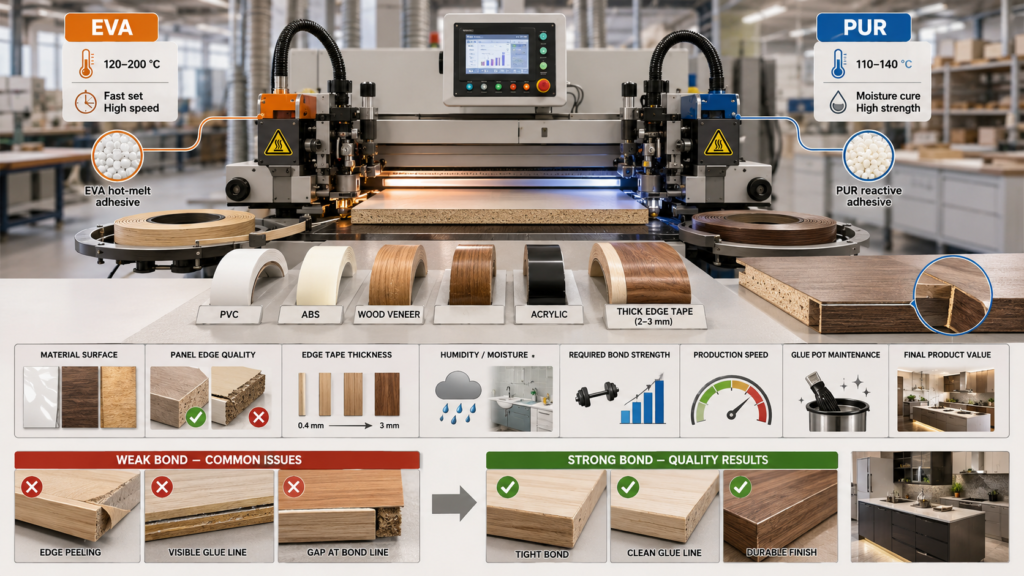
EVA is common for standard cabinet production because it is economical and easier to maintain. PUR can be better for moisture resistance, stronger bonding, and premium cabinet work, but it needs stricter cleaning and handling.
Glue selection should consider:
- material surface
- panel edge quality
- edge tape thickness
- humidity and moisture exposure
- required bond strength
- production speed
- glue pot maintenance
- final product value
Edge banding materials and adhesive choice should be reviewed together because weak bonding may appear as peeling, gaps, or visible glue lines.
If your shop already sees peeling or poor bonding, this guide to edge banding problems and fixes can help identify whether the problem comes from glue, pressure, temperature, material, or setup.
What Should Buyers Check Before Choosing a Machine for Mixed Materials?
Before choosing a woodworking edge bander, buyers should prepare a material list. This avoids buying a machine that looks strong on paper but does not match daily production.
Use this checklist:
1.Which edge banding materials do you use now?
2.Will you add ABS, veneer, acrylic, or high-gloss bands later?
3.What thickness range do you need?
4.Do you use EVA, PUR, or both?
5.Are the finished edges visible to customers?
6.Do light colors show glue lines?
7.Do you need pre-milling for board edge preparation?
8.Do you need scraping and buffing for premium panels?
9.Do you need corner rounding for doors and drawers?
10.How often will operators change materials?
11.Can the machine store or repeat settings?
12.Can your team clean glue and dust properly?
Workplace cleanliness is not only about appearance. HSE’s page on wood dust explains that wood dust can cause serious health problems and that employers must protect workers from dust hazards. Dust extraction and cleaning also help protect glue application and finishing quality.
Preguntas frecuentes
Do edge banding materials affect edge bander selection?
Yes. Material type affects glue choice, temperature control, pressure, trimming, scraping, buffing, feed speed, and whether advanced functions are needed.
¿Cuál es la diferencia entre el canteado de PVC y el de ABS?
PVC is widely used, flexible, and cost-effective. ABS is also a plastic edge banding material, often selected for toughness, clean processing, and higher-end cabinet applications.
Is wood veneer edge banding harder to process?
Yes. Wood veneer is natural and thin, so it needs sharp tools, controlled pressure, good dust extraction, and careful trimming or sanding.
¿cuál es el mejor material para bandas de bordes para gabinetes?
PVC is common for standard cabinets. ABS, acrylic, or high-gloss bands are often used for higher-end cabinets. Wood veneer is suitable for natural wood furniture.