
Noticias de la empresa
Why Edge Banding Peels Off: 9 Common Causes and How to Fix Them
Edge banding peeling is one of the most frustrating problems in panel furniture production. A cabinet door or countertop may look perfect when it leaves the machine, but the edge tape can start lifting after hours, days, or even weeks.
The reason is usually not the edge band itself. Why Edge Banding Peels Off is mainly related to adhesive conditions, machine adjustment, panel preparation, and production environment.
This guide explains the most common causes behind edge banding not sticking, how to identify the failure point, and what adjustments can improve edge banding adhesion in real production.
After reading this article, you should be able to diagnose whether the problem comes from glue temperature, glue application, pressure rollers, machine speed, MDF preparation, or working conditions.
Tabla de contenido
Why Does Edge Banding Peel Off After Production?
The short answer: because the adhesive does not create a strong enough bond between the edge tape and the panel surface.
A proper edge banding process requires four things to happen at the same time:
1.The glue must reach the correct melting temperature.
2.The adhesive must properly wet the panel surface.
3.The pressure system must press the edge tape evenly.
4.The panel and edge material must be clean and compatible.
If one of these steps fails, the bond may look acceptable at first but lose strength later.
Common symptoms include:
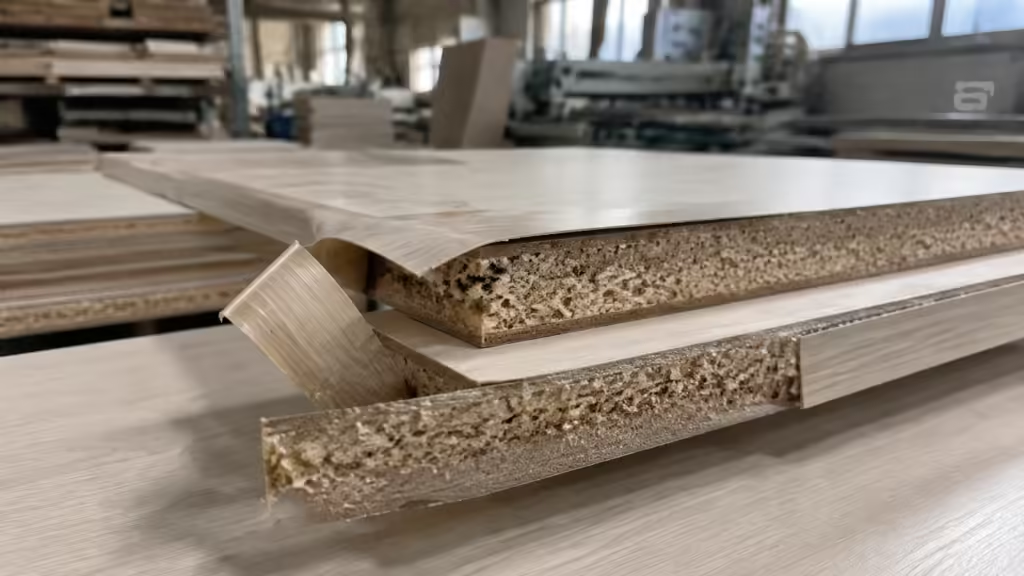
- Edge tape lifting from corners
- Complete separation from MDF
- Small gaps appearing after assembly
- Glue visible but not bonding
- Edge banding falling off after transportation
These symptoms often appear in furniture factories that increase production speed without recalibrating the edge banding machine settings.
How Does Edge Banding Adhesion Actually Work?
Understanding the bonding process makes troubleshooting much easier.
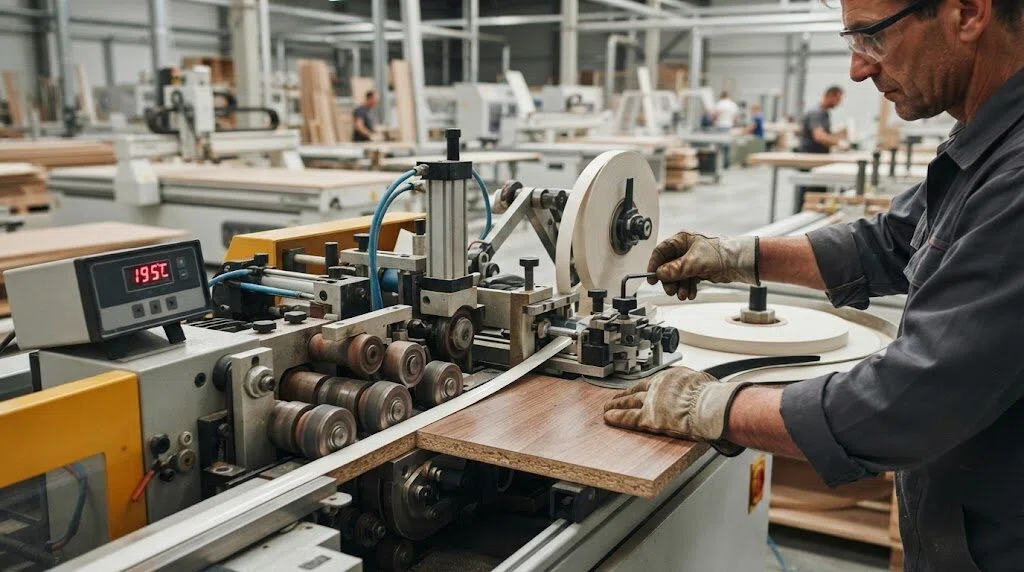
Most automatic edge banding machines use hot melt adhesives such as EVA or PUR. During production, the adhesive is heated, applied to the panel edge, and compressed by pressure rollers.
The bonding process includes three important stages:
1.Adhesive melting
The glue must reach the recommended processing temperature.
If the temperature is too low:
- The glue remains too thick.
- The adhesive cannot spread evenly.
- Contact with MDF fibers becomes weak.
If the temperature is too high:
- The adhesive may degrade.
- Open time becomes shorter.
- The glue may lose bonding performance.
De acuerdo a Henkel’s technical information on hot melt adhesives, hot melt bonding performance depends heavily on processing conditions such as temperature, application amount, and pressure.
2.Surface wetting
The melted adhesive must flow into microscopic irregularities on the MDF or particleboard edge.
A dusty, rough, or contaminated panel edge prevents proper contact.
This is why a clean machining surface is essential.
El Composite Panel Association (CPA) explains that wood composite panels contain different fiber structures and moisture characteristics that influence machining and finishing performance.
3.Pressure and cooling
After the edge tape contacts the panel, pressure rollers create the final bond.
Insufficient pressure can leave:
- Small air gaps
- Weak adhesive contact
- Uneven bonding along the edge
A good edge banding process is therefore not only about the glue. It is a combination of temperature, glue amount, pressure, speed, and material condition.
Is Your Edge Banding Glue Temperature Too Low?
One of the most common reasons for edge banding not sticking is incorrect glue temperature.
Many operators immediately increase glue quantity when they see peeling. However, the real problem may simply be that the adhesive is not hot enough to create proper wetting.
What happens when edge banding glue temperature is too low?
When hot melt adhesive is below the recommended working range:
- Glue viscosity becomes too high.
- The adhesive spreads unevenly.
- The glue layer cannot penetrate the MDF surface.
- Bond strength decreases.
The result is often:
- Edge tape comes off easily by hand.
- Glue remains on only one side.
- Corners peel first.
How to check edge banding glue temperature problems?
Verificați aceste puncte:
1.Compare actual temperature with machine display
Some machines display the set temperature, not the real glue pot temperature.
A temperature difference of several degrees can affect bonding performance.
2.Check adhesive type
Different adhesives require different temperature ranges.
For example:
- EVA hot melt usually operates at a different temperature range than PUR adhesive.
- Low-temperature adhesives are not interchangeable with standard formulations.
3.Observe glue appearance
Healthy hot melt adhesive usually forms a consistent coating.
Warning signs:
- Stringy glue
- Uneven coating
- Glue pulling away from the surface
How to fix edge banding glue temperature problems?
Try:
- Verify the actual glue pot temperature.
- Allow enough heating time before production.
- Clean old adhesive residue from the glue pot.
- Confirm the adhesive manufacturer’s recommended temperature range.
The correct temperature is not always the highest temperature. It should match the adhesive formulation and production speed.
Could Incorrect Glue Amount Cause Edge Banding Not Sticking?
Yes. Both too little glue and too much glue can create adhesion problems.
Many factories assume more glue means stronger bonding. In reality, excessive adhesive can reduce contact between the edge tape and panel.
Too little glue
When glue application is insufficient:
- The panel surface is not fully covered.
- Parts of the edge tape have no adhesive contact.
- Peeling usually starts from long straight sections.
Common causes:
- Glue roller setting too low
- Worn glue application roller
- Incorrect machine calibration
Too much glue
Excess adhesive can also create problems:
- Longer cooling time
- Glue squeeze-out
- Uneven pressure distribution
- Weak mechanical contact
A thick glue layer does not automatically create a stronger bond.
How much glue should be applied?
The correct amount depends on:
- Edge material
- Panel surface
- Adhesive type
- Machine speed
Instead of increasing glue blindly, operators should adjust:
- Glue roller position
- Application pressure
- Velocidad de alimentación
A balanced adhesive layer produces better edge banding adhesion than excessive glue.
Are Your Pressure Rollers Causing Adhesion Failure?
The pressure roller system is often overlooked because the glue receives most attention.
However, even correctly heated adhesive cannot bond properly if the edge tape is not pressed firmly against the panel.
Common pressure roller problems
Uneven roller pressure
One side bonds while another side lifts.
Typical signs:
- Only the upper or lower edge peels.
- Corners fail first.
Incorrect roller adjustment
If pressure is too low:
- Adhesive does not fully contact the panel.
If pressure is too high:
- Excess glue is squeezed out.
- Edge material may deform.
Damaged rollers
Worn rollers may create uneven pressure along the panel length.
Regular inspection is important, especially in high-volume furniture production.
How to fix pressure roller problems?
Check:
- Roller alignment
- Roller wear
- Pressure setting
- Panel thickness adjustment
A small mechanical adjustment can sometimes solve what appears to be a glue problem.
Are Edge Banding Machine Settings Too Fast?
Increasing production speed is common in furniture factories, but pushing an edge banding machine beyond the suitable working range can directly reduce bonding strength.
Many cases of edge banding not sticking happen because the machine runs faster than the adhesive system can handle.
How does feed speed affect edge banding adhesion?
The edge banding process requires enough time for:
- Aplicación de pegamento
- Material contact
- Pressure roller compression
- Initial cooling
When the feed speed is too high:
- The adhesive has less time to transfer heat.
- The glue may not fully wet the MDF edge.
- The pressure rollers have less contact time.
The result is often a weak bond that looks acceptable immediately but starts peeling later.
How to check if machine speed is the problem?
Compare production results at different speeds.
For example:
- Slow speed → strong bonding
- Fast speed → edge lifting
This usually indicates that the adhesive system cannot keep up with the machine settings.
How to fix edge banding machine settings problems?
Adjust:
- Velocidad de alimentación
- Temperatura del pegamento
- Pressure roller settings
- Glue application amount
Do not increase machine speed without recalibrating the entire bonding process.
De acuerdo a HOMAG’s woodworking technology information, edge banding performance depends on the interaction between machine parameters, adhesive processing, and material conditions.
Why Does Edge Banding Not Stick to MDF Panels?
A frequent search question from furniture manufacturers is:
Why does edge banding not stick to MDF?
The answer is often related to the condition of the MDF edge itself.
Even if the glue temperature and machine settings are correct, poor panel preparation can prevent proper bonding.
Common MDF-related causes
1.MDF edge dust
After cutting or machining, MDF edges can contain fine dust particles.
This dust creates a barrier between:
- Adhesive
- Wood fibers
The glue may stick to the dust instead of the panel.
2.Low-density MDF edges
Some MDF boards have softer edge structures.
During machining:
- Fibers may break away.
- The edge becomes uneven.
- Adhesive contact decreases.
3.Excess moisture
Wood-based panels react strongly to moisture changes.
According to the Wood Database information about MDF properties, MDF contains compressed wood fibers combined with resin, and its physical behavior is influenced by moisture exposure.
High moisture can affect:
- Surface stability
- Adhesive curing
- Bond strength
How to improve MDF edge bonding?
Before edge banding:
- Keep panels in a controlled environment.
- Remove machining dust.
- Check panel edge quality.
- Avoid processing damaged MDF edges.
For factories producing cabinets, wardrobes, and office furniture, panel preparation is often as important as the edge banding machine itself.
Can Workshop Temperature and Humidity Affect Edge Banding Adhesion?
Yes.
Many factories experience seasonal edge banding failures, especially during winter.
The same machine settings may work well in summer but fail when the workshop becomes cold.
Why does temperature affect edge banding?
Hot melt adhesive depends on heat transfer.
When the workshop temperature is low:
- MDF panels are colder.
- Edge tape loses heat faster.
- Adhesive may solidify before proper bonding.
This creates weak adhesion.
Signs of environmental problems
You may notice:
- Peeling happens mainly in winter.
- New production batches fail after cold storage.
- Edge bonding improves after panels warm up.
How to solve temperature-related problems?
Possible solutions:
- Maintain stable workshop temperature.
- Store panels indoors before production.
- Allow cold materials to reach room temperature.
- Adjust glue parameters according to seasonal conditions.
Environmental control is especially important for factories exporting furniture because production environments may vary significantly.
Is the Wrong Edge Banding Material Causing Peeling?
Not every edge tape works with every adhesive system.
Using the wrong combination of:
- Edge material
- Adhesive type
- Processing temperature
can cause long-term bonding problems.
Common edge material differences
PVC edge banding
Common in furniture production.
Usually works well with EVA and PUR adhesives.
ABS edge banding
Requires proper adhesive compatibility because surface characteristics differ from PVC.
Wood veneer edge banding
More sensitive to:
- Moisture
- Temperature
- Surface preparation
How to avoid material compatibility problems?
Before changing materials, confirm:
- Adhesive recommendation
- Processing temperature
- Machine capability
- Surface treatment requirements
A successful edge banding process is a system, not just a tape selection.
Are Dirty Panel Edges Reducing Bond Strength?
Surface contamination is another overlooked reason for edge banding adhesion problems.
Even a small amount of contamination can reduce adhesive contact.
Common contaminants include:
- MDF dust
- Oil from machinery
- Cleaning chemicals
- Old adhesive residue
How to fix surface preparation problems?
Before production:
- Clean cutting tools.
- Maintain sharp saw blades.
- Remove loose fibers.
- Keep panels away from oily surfaces.
A clean bonding surface allows the adhesive to directly contact the panel structure.
Why Does Edge Banding Peel Off Weeks After Installation?
Some failures do not appear immediately.
A panel may pass factory inspection but develop peeling after transportation or installation.
This usually indicates a hidden bonding weakness.
Common reasons for delayed peeling
Weak initial bonding
The edge tape was attached but did not achieve sufficient bond strength.
Temperature changes during transport
Furniture exported internationally may experience:
- Cold containers
- High humidity
- Temperature cycles
These changes can stress the adhesive joint.
Incorrect adhesive selection
For demanding environments, PUR adhesive may be considered because of its moisture resistance after curing.
Information from Jowat’s adhesive technology resources explains that adhesive selection should match the application requirements and processing conditions.
How to Fix Edge Banding Adhesion Problems: Practical Troubleshooting Checklist
Use this checklist before changing equipment or materials.
| Problem Symptom | Possible Cause | Recommended Check |
|---|---|---|
| Edge tape falls off immediately | Temperatura del pegamento demasiado baja | Check actual glue temperature |
| Corners peel first | Pressure roller issue | Adjust roller pressure |
| Glue stays on one side only | Poor wetting | Check glue temperature and surface condition |
| Peeling happens only on MDF | Panel surface problem | Check dust and moisture |
| Failure appears in winter | Workshop temperature issue | Warm materials before processing |
| Bond fails after weeks | Weak initial adhesion | Review adhesive and machine settings |
How to Prevent Edge Banding from Peeling During Daily Production
Preventing failure is easier than repairing finished furniture.
A practical maintenance routine includes:
Before production
Check:
- Temperatura del pegamento
- Glue condition
- Roller pressure
- Edge material compatibility
During production
Monitor:
- First few panels
- Glue coating appearance
- Edge alignment
- Finished bond strength
Weekly maintenance
Inspect:
- Glue pot cleanliness
- Pressure rollers
- Cutting tools
- Feeding system
Small adjustments prevent large production losses.
Frequently Asked Questions About Edge Banding Adhesion
Why does edge banding peel off after a few days?
Usually because the initial bond was weak. Common causes include low glue temperature, insufficient pressure, contaminated MDF edges, or incorrect adhesive settings.
Why does edge banding not stick to MDF?
The most common reasons are MDF dust, poor edge machining, incorrect glue temperature, or unsuitable machine settings.
¿a qué temperatura debe estar el pegamento para bandas en los bordes?
The correct temperature depends on the adhesive type. EVA and PUR adhesives have different processing requirements, so always follow the adhesive manufacturer’s technical data.
Can humidity affect edge banding adhesion?
Yes. Excess moisture can affect MDF stability and adhesive performance, especially during long-term storage or transportation.
How can I improve edge banding adhesion?
Start by checking four factors:
1.Glue temperature
2.Glue amount
3.Pressure roller adjustment
4.Panel surface condition
Most failures can be traced back to one of these areas.
Is PUR glue better than EVA for edge banding?
Not always. PUR can provide stronger moisture resistance after curing, but it also requires stricter processing control. The best choice depends on the furniture application and production conditions.
Conclusión
Why Edge Banding Peels Off is usually not caused by one single problem. The failure normally comes from a mismatch between adhesive temperature, machine settings, panel condition, and production environment.
When edge banding not sticking occurs, do not immediately replace the edge tape or increase glue volume. Start with a structured check:
- Confirm glue temperature.
- Verify glue application.
- Adjust pressure rollers.
- Review machine speed.
- Inspect MDF edges.
- Control workshop conditions.
A stable edge banding process comes from balancing every part of the system. Once these factors are controlled, manufacturers can significantly reduce peeling issues and improve long-term furniture appearance.
Preguntas frecuentes
Why does edge banding peel off after production?
Edge banding usually peels off because the adhesive does not form a strong bond with the panel edge. Common causes include incorrect glue temperature, insufficient pressure roller force, dirty MDF surfaces, or unsuitable machine settings.
Why does edge banding not stick to MDF?
Edge banding may not stick to MDF because of MDF dust, low-density edges, excessive moisture, low glue temperature, or incorrect adhesive application. Cleaning the panel edge and checking glue conditions are the first troubleshooting steps.
What is the correct edge banding glue temperature?
The correct glue temperature depends on the adhesive type. EVA and PUR hot melt adhesives have different processing requirements. Always follow the adhesive manufacturer’s recommended temperature range instead of increasing heat without checking.
Can low glue temperature cause edge banding to peel off?
Yes. Low glue temperature is one of the most common reasons for edge banding failure. When the adhesive is too cold, it cannot spread properly or create enough contact with the MDF surface.