
Industry News
Wood Cutting Machine Buying Guide: How to Choose the Right Equipment for Your Furniture Factory
Most furniture factories don’t fail in cutting operations because the machine is “bad.”
They fail because the wood cutting machine was selected without matching real production conditions.
Table of Contents
Why choosing a wood cutting machine is not a price decision
In furniture production, machine cost is only a small part of total lifecycle cost.
According to manufacturing system analysis from the U.S. National Institute of Standards and Technology (NIST), production efficiency is more strongly influenced by system configuration than individual equipment price NIST Smart Manufacturing Systems Overview.
In real factory environments, cost drivers include:
- Cutting accuracy stability over time
- Blade wear rate
- Operator dependency
- Rework ratio from panel defects
A cheaper machine often increases hidden costs through:
- higher material waste
- slower throughput
- inconsistent panel edges
A best cutting machine for furniture factory is not the most expensive one, but the one that matches production load without over-engineering.
What material are you cutting? This determines everything
Before choosing any wood cutting machine, material classification is the first decision point.
Different boards behave differently under cutting stress:
MDF (Medium Density Fiberboard)
- Dense fiber structure
- Requires stable blade speed
- Sensitive to overheating
Plywood
- Cross-layer structure
- Edge tearing risk if feed speed is incorrect
Particle board
- Low density, high chip risk
- Requires controlled cutting pressure
Solid wood
- Natural grain variation
- Requires adaptive cutting stability
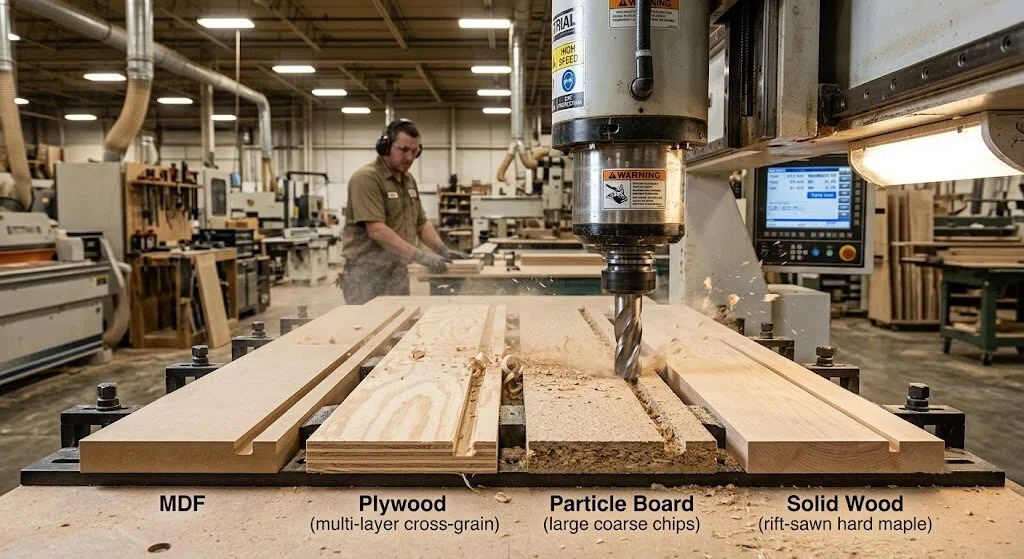
Material-first selection logic
Most buyers start from machine type.
Experienced factories start from material behavior.
A practical rule used in furniture production lines:
- If material is unstable, prioritize cutting stability.
- If material is stable, prioritize throughput.
This directly affects whether you choose:
- Straight line cutting machine (stable repetitive cuts)
- Disc cutting machine (high throughput straight cuts)
- Four process cutting machine (multi-step flexible production)
👉 This is where panel cutting machine selection becomes meaningful—not as a product category, but as a production strategy.
How cutting precision actually impacts furniture quality
Precision is often misunderstood as “higher is better.”
In reality, precision must match assembly tolerance downstream.
Typical factory ranges:
- ±0.1 mm → cabinet production, high-end furniture
- ±0.3 mm → standard panel furniture
- ±0.5 mm → structural or hidden components
Over-specifying precision leads to:
- higher machine cost
- slower cutting speed
- unnecessary maintenance load
Straight line vs disc cutting: when production reality decides
In furniture factories, two systems dominate:
Straight Line Cutting Machine
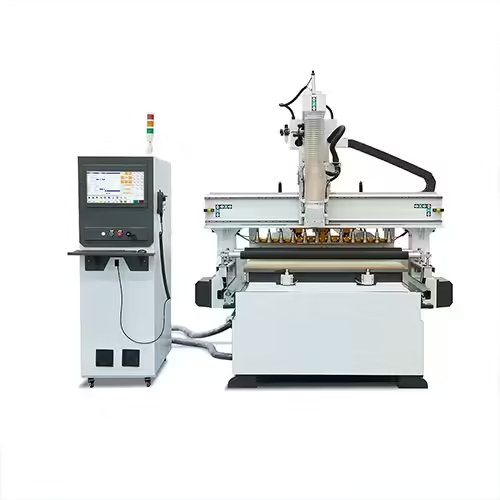
Best for:
- MDF panels
- repetitive straight cutting
- medium-volume cabinet production
A16 Disc Cutting Machine
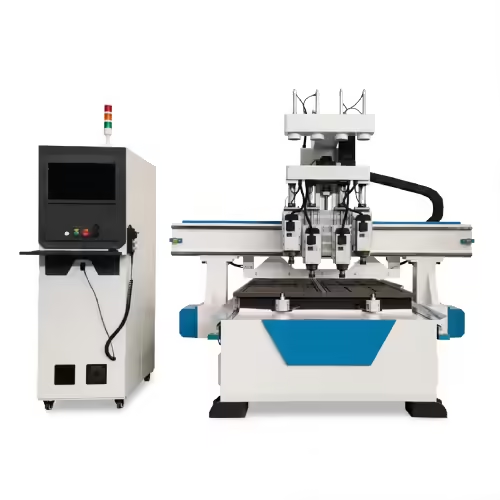
Best for:
- high-speed panel cutting
- mass production lines
- stable geometry materials
When “best cutting machine for furniture factory” is not one machine
A common misconception:One machine can handle all production.
In reality, most efficient factories use a combination system:
- Straight line for standard panels
- Disc cutting for high-volume output
- Four process machine for custom flexibility
This hybrid approach reduces:
- machine idle time
- operator dependency
- bottlenecks in cutting stages
Wood Cutting Machine Buying Guide: Production Capacity, Automation, and Factory-Level Decisions
Once material and cutting requirements are clear, the next real constraint is production capacity.
In furniture manufacturing, a wood cutting machine is never evaluated alone—it is evaluated as part of a production rhythm:
- daily output target
- shift structure
- order variability
- bottleneck position in the line
A system-level manufacturing study by MIT highlights that production throughput is constrained more by system balance than individual machine performance MIT Manufacturing Systems Overview.
This means a machine that is “technically strong” may still fail if it does not match factory flow.
Small workshop vs mass production
Different factory scales require different logic for selecting a woodworking cutting machine.
Small furniture workshop
Typical conditions:
- custom orders
- frequent design changes
- limited space
- lower automation demand
Recommended direction:
- Straight Line Cutting Machine
- flexible manual adjustment
- lower setup complexity
Medium furniture factory
Typical conditions:
- stable orders
- mixed materials
- moderate labor cost pressure
Recommended direction:
- Disc Cutting Machine
- partial automation
- stable throughput focus
Mass production furniture factory
Typical conditions:
- continuous production
- standardized products
- labor optimization required
Recommended direction:
- Four Process Cutting Machine
- automated workflow integration
- multi-step cutting system
Is automation really worth it in wood cutting machines?
Automation is often treated as a “premium feature,” but in furniture production it is mainly a labor-cost decision.
Key question:Does automation reduce bottlenecks or just replace operators?
In most factories, automation value comes from:
- reducing panel handling time
- stabilizing feeding accuracy
- minimizing human alignment errors
Wood Cutting Machine Buying Guide: Layout, Mistakes, and Final Selection Logic
Most furniture factories focus on machine capability, but ignore something more basic: floor layout.
A wood cutting machine does not operate in isolation. Its performance depends on how material flows through the factory.
Typical layout constraints that affect performance:
- distance between storage and cutting area
- panel movement path efficiency
- operator accessibility
- dust extraction positioning
- space for loading/unloading
Most factories make the same 5 buying mistakes
Choosing a woodworking cutting machine is often where factories lose money—not in operation, but in decision stage.
Mistake 1: Choosing based on price only
Low-cost machines often increase:
- rework rate
- material waste
- operator dependency
Mistake 2: Ignoring material expansion
Factories grow into:
- new board types
- higher density materials
- larger order volumes
But machines are often selected only for current demand.
Mistake 3: Overestimating CNC necessity
Not every factory needs full CNC automation.
In many cases, a panel cutting machine or straight line system delivers better ROI than complex automation.
Mistake 4: Underestimating maintenance structure
Key ignored factors:
- blade replacement cycle
- calibration frequency
- spare parts availability
Mistake 5: No production scalability planning
Machines should match future 2–3 year expansion, not just current orders.
How to choose a wood cutting machine
Instead of comparing brands, use this simple production-based framework:
Step 1: Identify material type
- MDF
- plywood
- particle board
- solid wood
Step 2: Define production scale
- small workshop → flexible cutting
- medium factory → balanced throughput
- mass production → continuous operation
Step 3: Choose cutting logic
- Straight Line Cutting Machine → stable repetitive production
- A16 Disc Cutting Machine → high-speed straight cutting
- Four Process Cutting Machine → flexible multi-stage production
Step 4: Check automation need
Ask:Does automation reduce labor, or just increase complexity?
Step 5: Confirm factory layout compatibility
Machine selection must match:
- space
- material flow
- operator movement
| Factory Type | Material Type | Recommended Machine |
|---|---|---|
| Small workshop | MDF / plywood | Straight Line Cutting Machine |
| Medium factory | mixed boards | Disc Cutting Machine |
| Large production | multi-material | Four Process Cutting Machine |
Final selection logic
A wood cutting machine is not a standalone purchase.
It is part of a production system where:
- material defines resistance
- capacity defines machine scale
- layout defines workflow efficiency
- automation defines labor cost structure
Factories that focus only on machine price usually end up optimizing the wrong variable.
FAQ
What is the best wood cutting machine for furniture factories?
It depends on production scale. Small workshops use straight line machines, while large factories prefer multi-process systems.
Can one wood cutting machine handle all materials?
No. MDF, plywood, and solid wood require different cutting stability and feed control.
Is CNC always necessary for furniture production?
Not always. Many factories achieve better ROI with simpler panel cutting systems.
How much space is required for a wood cutting machine?
Typically depends on model, but full production lines require dedicated loading and unloading zones.
What affects cutting accuracy most?
Material stability, blade condition, and feed alignment—not just machine brand.
How often should cutting blades be replaced?
It depends on material density and daily workload, typically monitored by output quality decline.