
Company News
Why Cabinet Factories Lose Accuracy in Cutting — and How Wood Cutting Machines Fix It
Cabinet production rarely fails at assembly. It usually fails much earlier—at the cutting stage.
A deviation as small as 0.3–1.0 mm in panel cutting can cascade into edge banding misalignment, gaps in carcass assembly, and rejected custom orders.
This article breaks down why cabinet factories lose cutting accuracy, and how a properly configured wood cutting machine for cabinet production stabilizes precision, reduces material waste, and improves downstream compatibility.
Table of Contents
Why cabinet factories lose cutting accuracy during production
Cutting errors are rarely caused by a single factor. They come from system instability across machine, material, and process control.
Is it machine error or process drift?
In most cabinet workshops, accuracy loss is not machine failure—it is cumulative drift.
Typical contributors:
- Tool wear over long batch runs
- Vibration from unstable table support
- Panel movement during cutting
- Nesting layout inefficiency
According to ScienceDirect research on CNC machining accuracy, dimensional errors often originate from dynamic system vibration and tool-path deviation, not static machine calibration.
Why small deviations become big problems in cabinets
Cabinet production amplifies error through repetition.
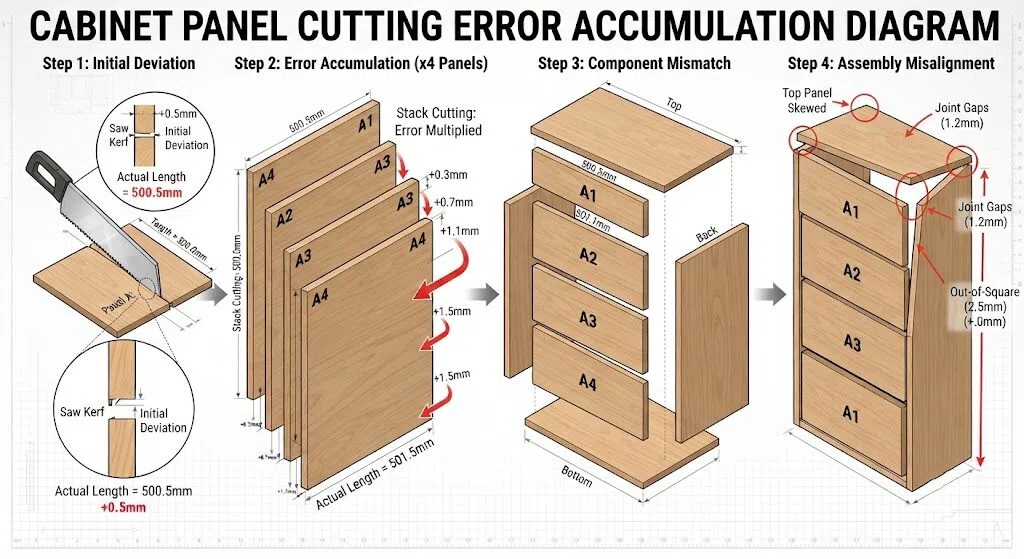
A single cutting error affects:
- door alignment
- hinge positioning
- drawer sliding tolerance
- edge banding alignment
A practical tolerance reference from Wikipedia’s dimensional tolerance overview shows that even small deviations in manufacturing accumulate into functional assembly failures.
What actually causes panel cutting inaccuracy in wood cutting machines?
Instead of treating all errors as “machine precision issues,” engineers usually separate causes into three systems.
1.Mechanical stability issues
Even CNC machines lose accuracy if mechanical conditions drift.
Common sources:
- guide rail wear
- spindle imbalance
- table vibration
- clamp pressure inconsistency
A technical foundation for precision engineering, NIST manufacturing research underscores the critical synergy between advanced measurement science and mechanical stability, demonstrating that production accuracy is not merely a function of control algorithms but is intrinsically limited by the geometric, thermal, and dynamic stability of the underlying manufacturing platform.
2.Material behavior during cutting
Wood panels are not stable materials.
- humidity changes
- internal stress release
- layered board density variation
This is especially visible in MDF and particle board used in cabinet production.
3.Tool path and nesting logic errors
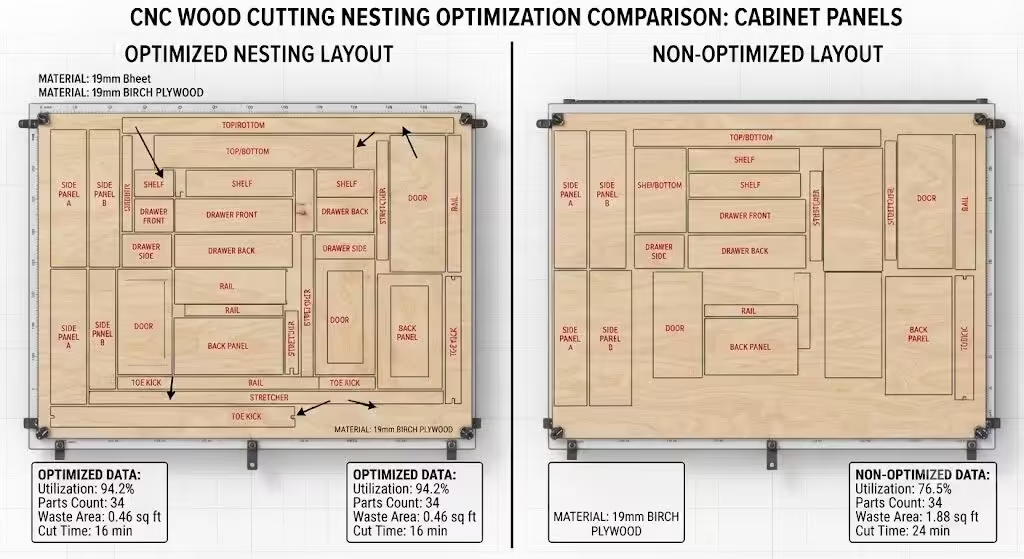
Nesting efficiency is often prioritized over stability.
Problems include:
- overly dense nesting layouts
- insufficient tool compensation
- poor grain direction control
How wood cutting machines improve cabinet production accuracy
A modern wood cutting machine for cabinets does more than cut panels. It stabilizes repeatability across production batches.
Why CNC control matters more than speed
In cabinet production, speed without stability increases rework.
A stable cabinet cutting machine improves:
- repeatable edge alignment
- consistent panel geometry
- predictable assembly fit
Nesting optimization and material utilization
Efficient panel cutting is directly linked to material cost.
Key optimization factors:
- sheet utilization rate
- cutting path minimization
- waste reduction logic
Why cutting accuracy improves edge banding compatibility
Cutting is not an isolated step—it directly affects edge banding and final assembly.
If panel edges are not accurate:
- edge banding shifts
- glue line becomes visible
- trimming overload increases
A practical industrial reference from Woodworking Network article on cabinet manufacturing efficiency (search: cabinet production efficiency trends) shows that downstream processes depend heavily on cutting precision stability.
Material utilization: where factories lose profit silently
Most factories focus on machine cost, but real loss happens in material waste.
Common causes:
- inefficient nesting strategy
- inconsistent panel size planning
- rework from inaccurate cuts
Even a 3–5% waste increase significantly impacts large batch orders.
How optimized cutting reduces waste
A stable cutting system improves:
- sheet utilization rate
- repeatable cutting patterns
- batch consistency

Production-level checklist used in cabinet factories
Before blaming machine accuracy, production teams usually check:
- blade or router bit wear condition
- vacuum table suction stability
- panel fixation pressure consistency
- humidity level of raw material
- nesting file optimization quality
A manufacturing control overview from ISO manufacturing standards documentation emphasizes that process control consistency is essential for dimensional accuracy in batch production systems.
Cabinet factories do not lose accuracy because of a single machine issue. They lose it because cutting, nesting, and material behavior are not treated as a unified system.
Once a stable wood cutting machine for cabinet production is integrated with controlled nesting logic and material handling discipline, cutting accuracy becomes predictable—not accidental.
FAQ
Why do cabinet panels not fit after cutting?
Because cumulative tolerance error appears across multiple panels, not a single cut failure.
How can cutting accuracy be improved in CNC wood cutting machines?
By stabilizing:tool condition,nesting logic,material fixation,machine calibration cycles
What is the best wood cutting machine for cabinet making?
Machines with stable CNC control, optimized nesting systems, and strong vacuum fixation are preferred for batch cabinet production environments.
Why does edge banding fail after cutting?
Because panel edges are not within tolerance range, causing misalignment during adhesive application.
Does faster cutting reduce accuracy?
In most cabinet production cases, yes—if speed increase is not balanced with feed rate and vibration control.