
Industry News
Is a Saw Table Type Edging Machine the Ultimate Space-Saver for Small Shops?
By reading this guide, you will learn exactly how to eliminate the operational bottleneck between your panel-cutting and edge-banding stations, reduce material handling damage, and maximize your shop’s square footage. Traditional small-to-medium cabinetry workshops lose thousands of dollars annually in non-value-added labor simply moving cut panels across the shop floor. Investing in a Saw Table Type Edging Machine solves this problem by executing both critical functions within a single unified workstation.
Table of Contents
How Panel Handling Kills Workshop Efficiency
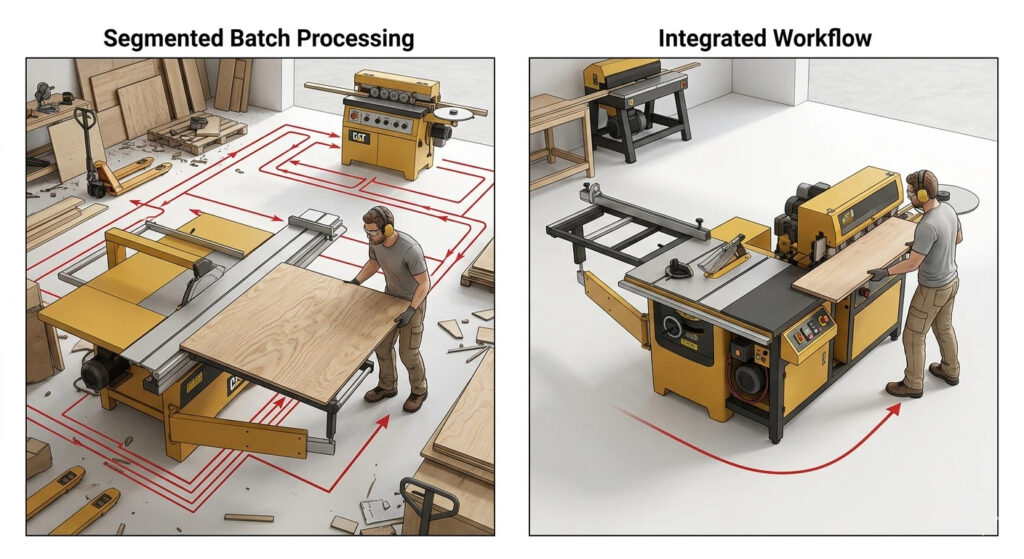
In a conventional furniture production sequence, a worker lifts a heavy sheet of plywood or MDF onto a sliding table saw, runs the cut list, and stacks the raw panels on a rolling cart. This cart is then wheeled across the shop to a standalone edge bander, where every single panel is lifted, oriented, and processed a second time. This segmented method introduces massive inefficiencies into your daily production metrics.
According to a comprehensive peer-reviewed industry analysis published by North Carolina State University, the storage, transport, and excessive handling of work-in-progress materials represent pure non-value-added waste that drastically cuts a woodworking firm’s competitive margins. You can read the complete strategic data in the BioResources Lean Manufacturing Study. The manual transit phase between machines is where your profits vanish.
Furthermore, every time a cut panel is handled, stacked, or rolled across a dusty floor, the risk of edge chipping, surface scratching, and corner damage spikes. If you are operating a custom shop, this workflow separation requires a massive physical footprint just to maintain in-feed and out-feed clearances for two separate heavy industrial units. Implementing a Saw Table Type Edging Machine addresses this challenge directly.
How Cutting and Banding Integration Resolves the Custom Cabinetry Process Gap

To overcome this process gap, modern custom shops are transitioning to hybrid machinery layouts. The primary goal of cutting and banding integration is to turn a multi-stage transport loop into a single-point operation. By marrying the raw panel sizing mechanics directly with the post-cut edging sequence, you eliminate intermediate buffering entirely.
This mechanical layout transforms how a single woodworker manages panel throughput. Instead of processing entire batch cut lists before moving to the edge bander, the operator shears the piece and immediately passes it through the edging unit. This creates a continuous, single-piece flow line that mimics high-end automated industrial cells but on a compact budget.
Engineering Blueprint of a Modern Saw Table Type Edging Machine
The internal architecture of this specialized equipment is engineered to maintain rigid alignment under continuous mechanical stress. A premier Saw Table Type Edging Machine integrates a heavy-duty circular saw table with a fully functional automatic edge banding track. Both sub-systems share a stabilized, vibration-dampening steel monoblock frame.
The system is equipped with independent high-torque motors built to standard industrial electrical tolerances. The cutting side utilizes a main blade paired with a secondary scoring blade to guarantee chip-free cuts on double-sided melamine or veneered panels. Directly adjacent to the saw fence sits the edge banding track, which features a heated, Teflon-coated hot-melt glue pot, synchronized pneumatic pressure rollers, automatic tape feeding, automatic end-trimming, and high-speed flush-trimming motors.
This specific mechanical configuration delivers a mini edging machine with integrated saw table for efficient workflow, allowing a single worker to cut a panel to size and instantly edge-band the raw border without taking more than a single step. The close proximity of the systems ensures that the freshly cut edge is free of workshop dust contamination, optimizing the adhesion strength of the hot-melt polyurethane or EVA glue bond. This makes it an ideal 2-in-1 woodworking machine for cabinets where joint seamlessness determines final product value.
Using a Saw Table Type Edging Machine means the operator does not have to recalibrate fences or worry about cumulative tolerances across two different machine beds. The edge-banding guide rail is aligned with precision machining tolerances relative to the cutting plane, ensuring squareness and flawless consistency across long production runs.
Small Workshop Edge Bander Ideas: Reducing Worker Fatigue and Floor Space
When searching for small workshop edge bander ideas, many owners overlook the severe physical toll of manual material handling. Lifting heavy MDF and hardwood panels multiple times per shift leads to rapid physical exhaustion, degraded focus, and expensive cutting errors.
A longitudinal occupational health study published on the National Center for Biotechnology Information (NCBI) platform confirms that woodworkers and panel processors suffer exceptionally high rates of work-related musculoskeletal disorders (WMSDs). This chronic physical stress is primarily triggered by repetitive manual material handling, excessive lifting of heavy sheet goods, and awkward postures during stock movement. You can review the full clinical evaluation and risk data in the NCBI Woodworking WMSD Study.
Additionally, specialized ergonomic research hosted on PubMed highlights that integrating separate processing steps into unified workstations drastically lowers thoracic and lumbar strain on operators. The complete mechanical and human factors analysis is documented in the PubMed Ergonomics and Woodworking Analysis.
By implementing a Saw Table Type Edging Machine, you cut the physical lifting requirements exactly in half. The operator places the panel on the saw table once, completes the primary rip and crosscuts, and moves the finished component into the edge-banding feed system at waist height. This localized sequence eliminates the need for constant bending, carrying, and reloading, keeping your labor force safe and productive.
Beyond the human element, shop floor ergonomics require smart spatial design. Standard standalone machines demand extensive clearance fields:
| Machine Setup Type | Required Processing Area (Sq. Ft.) | Labor Allocation | Material Risk Profile |
| Standalone Table Saw + Separate Bander | 350 – 450 Sq. Ft. | 2 Operators Needed | High (Multiple handling loops) |
| Saw Table Type Edging Machine | 120 – 160 Sq. Ft. | 1 Operator Solo | Low (Single-point execution) |
Calculating the Spatial ROI of a Combined Table Saw and Edge Bander
Commercial real estate costs make shop footprint a critical variable in your overall operational margins. Relying on a combined table saw and edge bander allows you to unlock valuable floor space that can be repurposed for an assembly station, a finishing booth, or raw material storage.
This integration makes the unit a premier choice among space-saving woodworking machines. By condensing two heavy industrial footprints into a single station, you save up to 60% of the active floor zone normally occupied by processing channels, out-feed rollers, and material buffer zones. For micro-workshops, mobile container shops, or urban custom fabrication spaces, this spatial conservation can make the difference between a viable business model and a lease deficit.
The operational return on investment goes beyond real estate. By consolidating your machinery line into a single Saw Table Type Edging Machine, your aggregate power drop requirements, dust collection ducting networks, and pneumatic supply plumbing lines are slashed. You only need to run one main dust extraction hookup to the unit rather than routing complex, static-prone flexible piping to opposite sides of the warehouse.
Final Verdict
Transitioning your cabinetry production line over to a dedicated Saw Table Type Edging Machine eliminates the costly, fatigue-inducing gaps inherent in old-school batch-and-queue shop layouts. By joining high-precision panel breakdown mechanics directly with synchronized edging processing, you create an uninterrupted, single-operator manufacturing flow. This shift fundamentally optimizes your shop’s hourly throughput, minimizes material handling defects, and maximizes the financial yield of every square foot of your lease.
When analyzing the long-term equipment acquisition cost, the financial case for a highly integrated unit becomes undeniable. Rather than funding separate electrical hookups, duplicate dust collection lines, and multiple equipment service contracts, a shop owner can stabilize their overhead using a single versatile system. If you are ready to modernize your custom shop, cut down production friction, and scale your daily output, investing in a robust Saw Table Type Edging Machine is the single most efficient workflow decision you can make this fiscal year.
FAQ
Can a Saw Table Type Edging Machine handle heavy industrial panel sizing daily?
Yes. While compact, a premium Saw Table Type Edging Machine utilizes a rigid, heavy-gauge steel monoblock chassis and independent industrial motors that easily support continuous cutting of engineered panels without losing accuracy or squareness.
How does the integrated dust collection system protect the hot-melt glue pot from contamination?
The system features isolated internal vacuum shrouds. The saw blade housing is completely sealed from the edge-banding bay, routing high-velocity wood dust downward through a primary extraction port before it can migrate toward the open adhesive reservoir.
What types of edge banding materials are compatible with this Saw Table Type Edging Machine?
The automated tape feed mechanism processes PVC, ABS, natural wood veneer, and thick melamine edge-banding coils ranging from 0.4mm to 3.0mm in thickness seamlessly.
Does a Saw Table Type Edging Machine require special operator training compared to separate units?
No. The centralized control panel features intuitive independent switches for the saw arbor, glue pot heating elements, and track feed speed, allowing any intermediate woodworker to master the system in a single shift.