
Industry News
Does Edge Bander Pre Milling Really Make Cleaner Panels?
If your finished panels show visible glue lines, rough edges, small chips, or inconsistent edge banding results, the problem may start before the glue is even applied. Edge bander pre milling is designed to prepare the panel edge first, so the edge tape can bond to a cleaner, straighter surface.
Table of Contents
Why Panel Edges Cause So Many Edge Banding Problems
Many factories blame glue, edge tape, or machine speed when the finished edge looks poor. Those factors matter, but the panel edge itself is often the first source of trouble.
After cutting or nesting, MDF, particle board, plywood, or laminated panels may still have saw marks, micro-chipping, burrs, dust, or slightly uneven edges. If the board edge is not flat and clean, the glue layer cannot sit evenly. The edge band may still stick, but the result can show a thicker glue line, weak bonding points, or a rough transition between panel and tape.
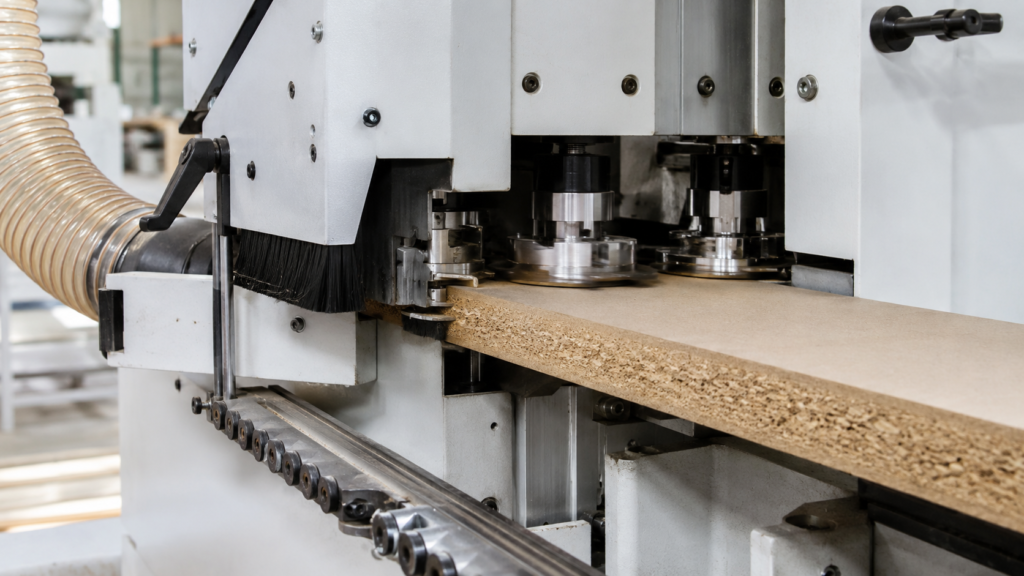
What Edge Bander Pre Milling Actually Does
Edge bander pre milling is a machining step placed before glue application. It uses rotating cutterheads to remove a very small amount of material from the panel edge. The goal is not to resize the whole board aggressively. The goal is to remove saw marks, small chips, uneven cutting lines, and minor edge defects.
In practice, edge bander pre milling creates a cleaner reference surface for the next steps: glue application, pressure bonding, trimming, scraping, and buffing. It is the foundation step that helps the rest of the machine work more consistently.
Does Edge Bander Pre Milling Reduce Visible Glue Lines?
A visible glue line is not always caused by the glue itself. It can also be caused by an uneven panel edge. When the edge is rough or slightly chipped, glue fills the irregular gaps. This can make the glue line look thicker or less consistent.
Edge bander pre milling helps by making the panel edge flatter before glue is applied. A cleaner edge allows more uniform contact between the board, adhesive, and edge tape. That can help reduce uneven glue lines, especially on visible cabinet parts, wardrobe panels, high-gloss boards, and light-colored surfaces.
How Edge Bander Pre Milling Improves Adhesion
Adhesion depends on surface contact. If the panel edge has dust, loose fibers, small chips, or cutter marks, the adhesive may not bond evenly across the full edge.
Edge bander pre milling helps remove the unstable outer edge layer created by cutting. This is especially useful for MDF and particle board, where the edge can be dusty or slightly broken after sawing. A smoother edge allows the glue system and pressure rollers to work with less variation.
This does not mean pre-milling can fix every problem. If the panel is badly damaged, warped, wet, or cut inaccurately, pre-milling can only improve part of the issue. Good edge banding still needs stable feeding, correct glue temperature, clean pressure rollers, and properly adjusted trimming tools.
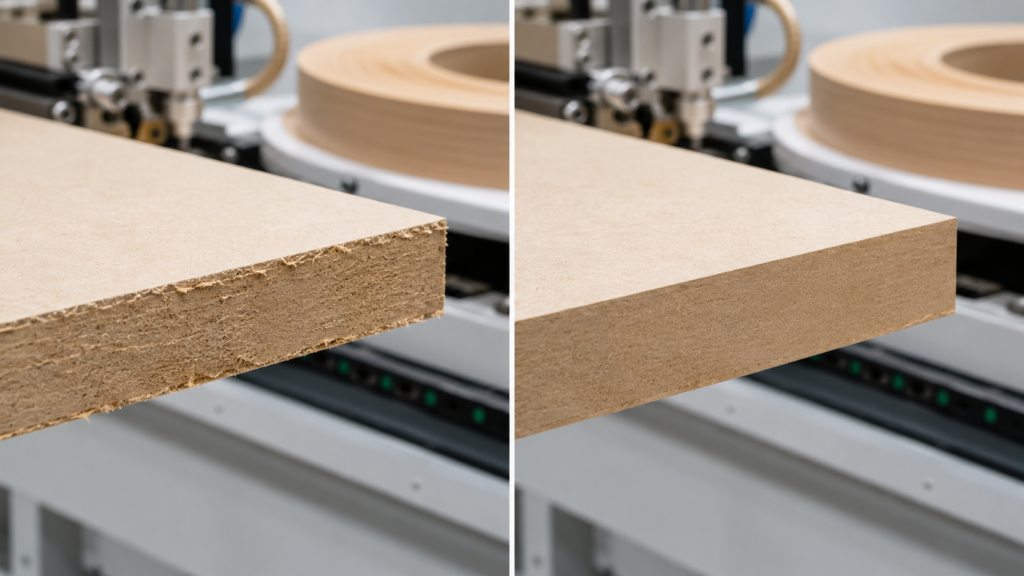
With and Without Edge Bander Pre Milling What Changes
Edge bander pre milling is easiest to understand when you compare the finished result.
| Factor | With Pre Milling | Without Pre Milling |
|---|---|---|
| Panel edge | Cleaner and straighter | May keep saw marks or chips |
| Glue line | More consistent | More likely to look uneven |
| Adhesion | More stable contact | Depends heavily on cutting quality |
| Appearance | Cleaner edge transition | Rough edge may show through |
| Best use | Visible panels and higher-quality furniture | Basic panels with stable cutting quality |
For cabinet doors, wardrobes, office furniture, and visible panel edges, the difference can be noticeable. In low-cost hidden parts, the value may be less obvious.
When Edge Bander Pre Milling Is Worth the Upgrade
Edge bander pre milling is worth considering when panel appearance affects customer acceptance. It is especially useful for:
- Cabinet doors and wardrobe panels
- PET, acrylic, high-gloss, or light-colored panels
- Panels with many visible edges
- Factories using CNC nesting or panel saws that sometimes leave chips
- Batch production where consistency matters
- Furniture lines where manual repair is already taking too much time
The biggest value is not one perfect sample. The value is repeatability. If a factory produces hundreds of panels per day, even small improvements in glue line consistency and edge smoothness can reduce rework.
Buyer Insight: Pre-milling is not only a “premium” feature. In some shops, it is a way to protect profit by reducing hand correction after edge banding.
When Edge Bander Pre Milling May Not Be Necessary
Edge bander pre milling is useful, but it is not mandatory for every workshop.
It may be less important if your panel cutting quality is already excellent, your products are low-cost utility items, most edges are hidden, or your production volume is small. A factory with very stable CNC cutting, sharp tooling, and moderate finish requirements may not see the same return as a cabinet shop making visible high-end panels.
The decision should come from product positioning. If customers judge the finished edge closely, pre-milling has stronger value. If the edge is rarely visible, the investment may be harder to justify.
Buying Checklist for an Edge Bander Pre Milling Unit
When comparing machines, do not only ask whether the machine “has pre-milling.” Ask how well the unit is built and how easy it is to adjust.
Check these points:
1.Cutterhead quality and diameter
2.Motor power and stability
3.Cutting amount adjustment
4.Dust extraction design
5.Panel thickness range
6.Feed stability
7.Fence and guiding accuracy
8.Cutter replacement cost
9.Access for cleaning and maintenance
10.Compatibility with glue, pressure, trimming, scraping, and buffing units
Pre-milling produces dust and chips, so extraction should not be ignored. HSE guidance on wood dust says both hardwood and softwood dusts have workplace exposure limits, and OSHA explains that engineering controls such as exhaust ventilation systems are preferred for controlling wood dust exposure.
Common Mistakes That Reduce Pre Milling Results
Edge bander pre milling works best when it is adjusted and maintained correctly. Common mistakes include:
- Removing too much material and changing panel dimensions
- Running dull cutters too long
- Ignoring dust extraction
- Feeding unstable or warped panels
- Assuming pre-milling can replace accurate cutting
- Forgetting to check cutter alignment
- Using the same setting for every material
How Pre Milling Works with Glue Pressure and Finishing Units
Edge bander pre milling is only one part of the edge banding process. It prepares the panel edge, but the final result still depends on the full machine sequence.
The glue system controls adhesive coverage. The pressure rollers control bonding contact. End trimming and fine trimming control edge shape. Scraping and buffing improve the final feel and appearance. If these later units are poorly adjusted, even a clean pre-milled edge may not create a premium result.
The glue system controls adhesive coverage. The pressure rollers control bonding contact. End trimming and fine trimming control edge shape. Scraping and buffing improve the final feel and appearance. If these later units are poorly adjusted, even a clean pre-milled edge may not create a premium result.
This is why buyers should evaluate the entire edge banding machine, not a single feature. Pre-milling creates a better starting point, but consistent finished panels require the whole process to work together.

Conclusion
Edge bander pre milling really can help make cleaner panels, but not because it is a magic feature. It works because it prepares a straighter, smoother, more stable panel edge before glue is applied.
For factories struggling with visible glue lines, rough edges, weak adhesion, or inconsistent finished panels, edge bander pre milling can be a practical upgrade. The best results come when pre-milling works together with accurate cutting, stable feeding, the right glue system, correct pressure, sharp trimming tools, and good dust extraction.
FAQ
What does edge bander pre milling do?
It trims the panel edge before glue application to remove saw marks, small chips, burrs, and uneven surfaces.
Does pre milling reduce glue lines?
Yes, it can help make glue lines more consistent by creating a smoother panel edge, but glue type, temperature, glue amount, and pressure also matter.
Is pre milling useful for MDF and particle board?
Yes. MDF and particle board edges can be dusty or rough after cutting, and pre-milling helps prepare a cleaner bonding surface.
Can pre milling fix poor cutting quality?
It can improve minor saw marks and small chips, but it cannot fully correct badly damaged panels or inaccurate cutting.
Does pre milling change panel size?
It can remove a small amount of material. The machine setting and production plan should account for that cutting amount.