
أخبار الصناعة
هل تؤثر سرعة Edge Bander على جودة Edge Banding؟
edge bander speed is one of the first numbers buyers notice when comparing machines, but it should not be treated as a simple “faster is better” feature. In real panel furniture production, speed affects glue open time, pressure stability, trimming accuracy, and final edge banding quality.
This article explains how to choose a practical speed range, why faster edge banding causes defects, and what to check before increasing the feed rate on an automatic edge bander.
جدول المحتويات
Why edge bander speed should not be judged alone
edge bander speed usually describes how fast the panel travels through the machine, often measured in meters per minute or feet per minute. A higher number can improve output, but only when the glue system, pressure rollers, trimming units, board material, edge tape, and operator setup can keep up.
So the better question is not “What is the fastest machine?” The better question is: “What is the best edge banding machine speed for stable quality?”
Open time is where speed problems often begin
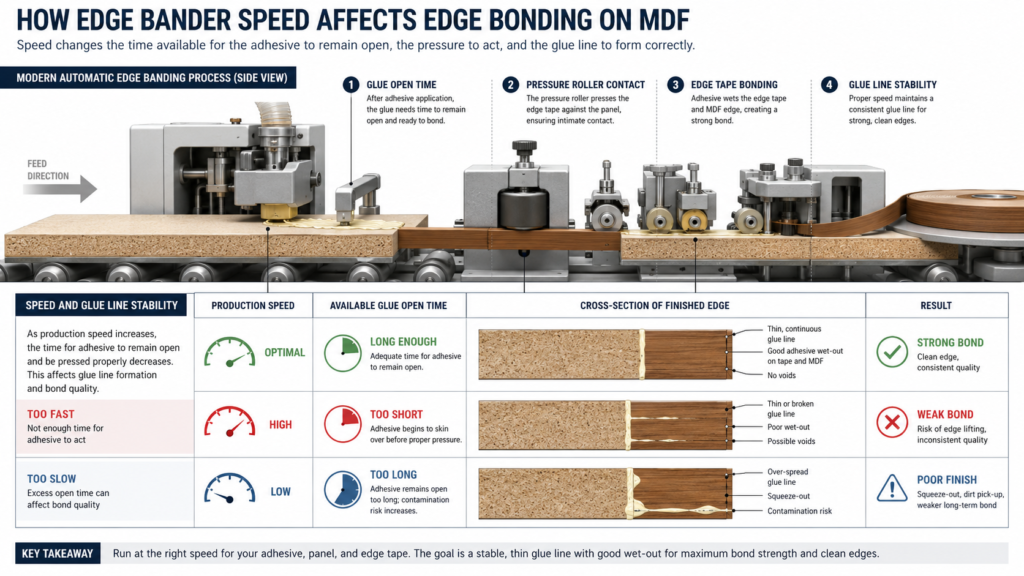
The most important connection between edge bander speed and glue quality is adhesive open time. Open time is the window after adhesive application when a reliable bond can still be made.
Smithers explains that a hot melt with an open time of 1–2 seconds may form a poor bond if the process needs 4–5 seconds before the substrates meet. Lanco Adhesives also defines open time as the maximum time between applying adhesive and bringing the surfaces together; if the adhesive exceeds that time, proper adhesion may not occur.
In an edge banding line, the panel must move fast enough for production but slow enough for the glue to wet the board edge and bond with the edge tape. If edge bander speed is too high for the glue and machine setup, the result can be a weak glue line, edge lifting, or peeling after handling.
This is why hot melt glue temperature, shop temperature, board temperature, edge tape material, and pressure timing all matter.
How excessive speed reduces edge banding quality
When factories ask, “does edge bander speed affect quality?” the answer is yes, but the problem usually appears as a combination of defects.
Common speed-related problems include:
- visible glue line
- incomplete bonding
- tape shift or misalignment
- edge lifting after cooling
- rough trimming
- chatter marks
- excessive scraping
- extra buffing or sanding
edge bander speed becomes risky when the panel passes through the pressure zone before the glue has the right wetting condition. It also becomes risky when trimming cutters, scraping units, and buffing wheels cannot remain stable at the chosen feed rate.
Woodworking Network’s edgebanding troubleshooting guide notes that an unclosed glue joint can be related to pressure, cold edgebanding material, adhesive suitability, and feed rate adjustments. That is why speed cannot be separated from temperature, pressure, and material condition.
Why faster edge banding causes trimming defects
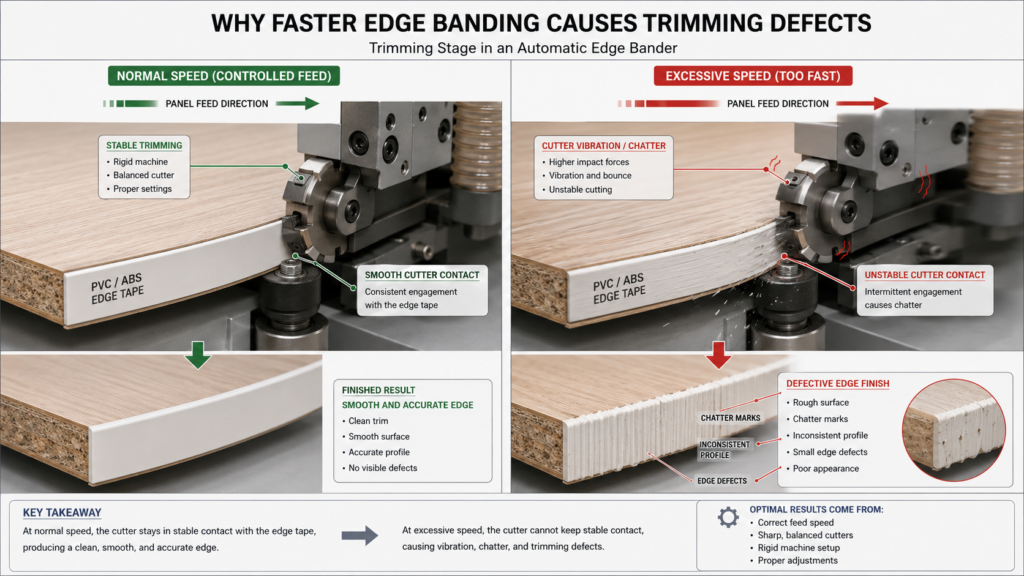
The trimming stage is another reason edge bander speed needs control. When the panel moves too fast, trimming units may leave chatter marks, rough edges, or inconsistent profiling.
A RAMS Industries edgebanding troubleshooting guide lists “feed rate is too high” as one possible cause when chatter marks are visible after trimming. This is important for PVC, ABS, veneer, and melamine edges because the customer sees the final trim quality, not the machine’s advertised speed.
In simple terms, the edge tape may be bonded, but the finished edge can still look poor. That is why edge banding quality depends on both bonding and machining accuracy.
What is the best آلة ربط الحواف speed?
There is no single best edge banding machine speed for every workshop. The right setting depends on the machine design, glue type, edge tape, panel thickness, panel length, and quality target.
A practical starting point is to match edge bander speed with these factors:
| عامل | What to check |
|---|---|
| نوع الغراء | EVA, PUR, or other hot melt system |
| Edge material | PVC, ABS, veneer, melamine, solid wood |
| Panel type | MDF, particle board, plywood, laminated board |
| Tape thickness | Thin tape vs thick edge banding |
| Shop condition | Cold board, dust, humidity, and temperature |
| Required finish | Standard cabinet edge vs premium visible edge |
H.B. Fuller explains that hot melt adhesives are solid at room temperature and become activated when heated beyond the softening point before being applied in molten form. For edge banding, that means glue temperature and speed must work together. A fast machine with poor glue control will not produce premium edges.
Automatic edge bander settings that matter besides speed
An automatic edge bander should not be judged by speed alone. The machine must keep the full process stable.
Before increasing edge bander speed, check:
1.Glue pot temperature or glue application system
2.Pressure roller alignment
3.Tape feeding stability
4.Panel feeding accuracy
5.Trimming cutter sharpness
6.Scraper setting
7.Buffing wheel condition
8.Dust extraction
9.Air pressure stability
10.Material storage temperature
If these areas are unstable, increasing edge bander speed only makes the defect appear faster.
For panel furniture production, consistency is usually more valuable than top speed. A stable 12 m/min line with low rework can outperform a faster line that creates peeling, chatter, or polishing defects.
How to test speed before full production
Do not increase edge bander speed on a full order first. Run test panels.
A simple test method:
- Use the same board, tape, and glue as production.
- Start at a moderate speed.
- Inspect glue line and pressure marks.
- Check trim smoothness under side lighting.
- Cut samples after cooling and check adhesion.
- Increase speed step by step.
- Stop when defects begin to appear.
This process helps identify the upper quality limit of the machine, not just its maximum mechanical speed.
Final advice for panel furniture production
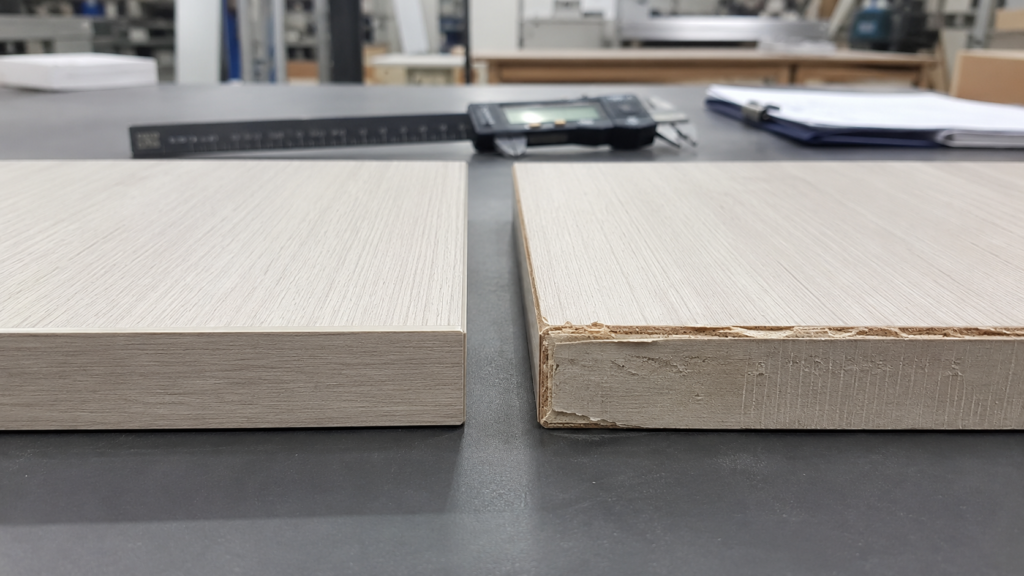
edge bander speed directly affects quality, but it is only one part of the process. The best results come from balancing speed with adhesive open time, pressure stability, trimming precision, and material condition.
For panel furniture factories, the goal is not to run the fastest possible line. The goal is to run the fastest stable line. If your automatic edge bander can maintain clean glue lines, strong adhesion, smooth trimming, and low rework, then the speed is right.
To improve output without sacrificing edge banding quality, choose equipment and settings that support stable production—not just a higher edge bander speed number.
التعليمات
Does edge bander speed affect glue adhesion?
Yes. If the panel moves too fast for the adhesive open time and pressure zone, glue transfer and bonding can become weak.
What is the best edge banding machine speed?
The best speed depends on glue type, panel material, tape thickness, machine setup, and finish requirements. Test panels before full production.
Why does faster edge banding cause defects?
Faster feed can reduce bonding time, increase trimming vibration, and make pressure or tape alignment problems more visible.
Can an automatic edge bander run fast and still produce good edges?
Yes, but only when glue temperature, feed stability, pressure rollers, trimming units, and materials are properly matched.
Should I reduce speed if the glue line is visible?
Often yes, but also check glue temperature, pressure, board dust, tape material, and scraper settings.