
أخبار الشركة
How to Choose an Edge Banding Machine for Cabinet Production
Choosing the right edge banding machine for cabinet production is not about buying the machine with the highest speed or the longest feature list. It is about matching the equipment with your actual production: the panels you process, the edge materials you use, the number of cabinets you make every day, and the finishing standard your customers expect.A small custom cabinet workshop, a mid-sized furniture factory, and an industrial kitchen cabinet manufacturer may all need an edge bander, but they usually need completely different configurations.
جدول المحتويات
What should an edge banding machine for cabinet production handle in your daily workflow?
The first mistake many buyers make is starting with machine speed.
A better starting point is your product mix.
A cabinet factory may process:
- standard cabinet side panels
- shelves and fillers
- kitchen cabinet doors
- curved reception furniture
- bathroom vanity panels
- decorative beveled panels
Each application creates different requirements.
As explained in Woodworking Network’s edgebander selection guide, edge banding is not only a finishing process. It also protects panel substrates from moisture, impact, and daily wear.
For cabinet manufacturers, the correct machine usually depends on the following factors:
Straight cabinet panels
If most of your production consists of:
- cabinet carcasses
- shelves
- rectangular doors
- standard furniture panels
a continuous automatic edge banding machine is usually the most logical choice.
The workflow is simple:
panel feeding → gluing → pressing → trimming → scraping → polishing
The more consistent the panel size, the more value automation can provide.
Curved and irregular panels
Custom furniture manufacturers often face a different situation.
A machine designed only for straight panels may not handle:
- curved cabinet doors
- round tables
- irregular decorative panels
efficiently.
For these applications, a curved edge banding machine or semi-automatic profiling machine can be more practical.
For example, the آلة ربط الحواف المنحنية المستقيمة D5 is designed for both straight and curved edge processing, which fits workshops producing customized furniture rather than only standardized cabinet panels.
Narrow parts and special components
Small components create another challenge.
أمثلة:
- narrow drawer strips
- cabinet fillers
- decorative strips
- small furniture components
A machine that performs well on large panels may not always provide stable feeding on narrow parts.
This is why minimum panel size should be checked before purchase.
ال DWS-190 Fully Automatic Head and Tail Sealing and Repairing Machine is an example of equipment designed around panel finishing consistency, including straight and curved processing requirements.
Beveled cabinet panels
Some modern furniture designs use angled edges instead of standard 90-degree edges.
For these applications, a normal edge bander may not be enough.
A bevel edge banding machine is designed for controlled angle processing.
ال XZF450 Full-Automatic Bevel and Straight Edge Banding Machine supports angle adjustment for different decorative requirements, making it suitable for furniture manufacturers producing special profile panels.
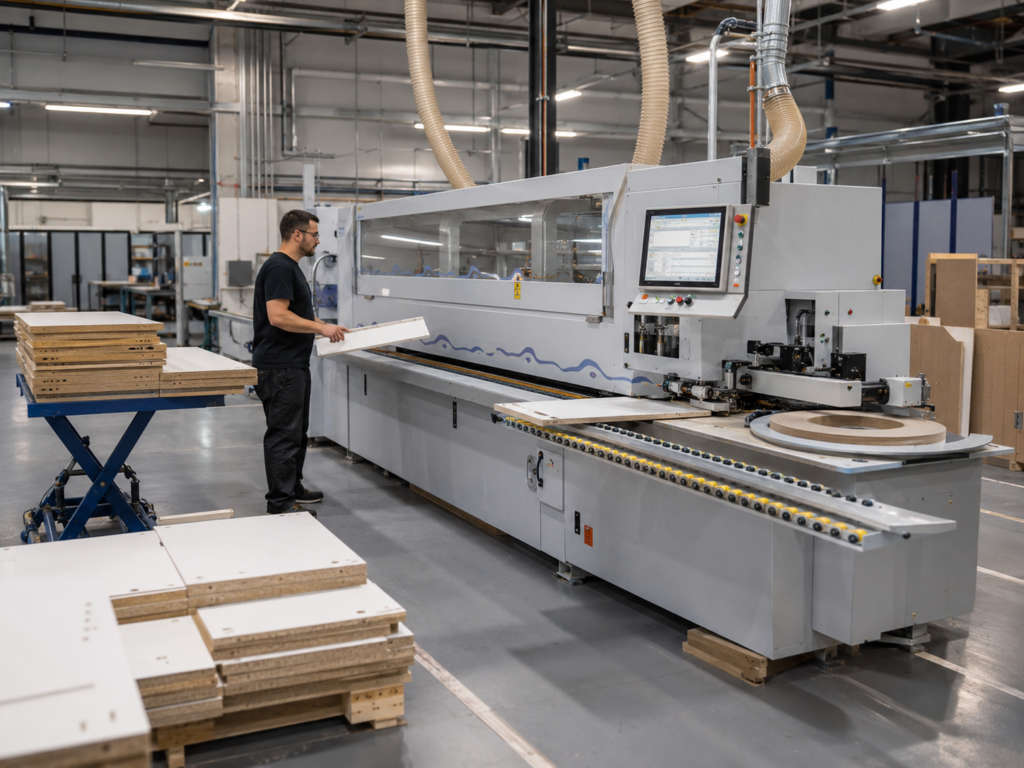
Is a compact or semi automatic edge banding machine enough for a small cabinet shop?
For many small workshops, the answer is yes.
A common purchasing mistake is assuming:
“More automation always means better.”
That is not always true.
A small cabinet shop may have:
- changing orders every day
- different panel shapes
- limited production space
- low batch quantities
In this situation, flexibility can be more valuable than maximum speed.
A suitable machine for a small cabinet workshop should provide:
- easy operation
- quick adjustment
- low space requirement
- ability to process different panel types
This is why many small manufacturers choose a semi automatic edge banding machine.
When does a mini edge banding machine make sense?
A mini edge banding machine is usually suitable for:
- small furniture workshops
- cabinet repair businesses
- startups
- on-site furniture installation
The advantage is not production speed.
The advantage is flexibility.
For example:
- the machine can be moved easily
- operators can process individual panels quickly
- investment risk is lower compared with industrial equipment
Your آلة ربط الحواف الصغيرة is positioned around this type of application, while the آلة حواف صغيرة من نوع طاولة المنشار focuses on compact processing for smaller workshops.
When should a workshop choose a semi automatic edge bander?
Semi automatic equipment becomes attractive when production contains both:
- straight panels
- curved or irregular panels
A fully automatic straight-line machine is excellent for repetitive cabinet production.
However, if every order contains different shapes, operators may spend more time adjusting the production process.
A semi automatic curved machine allows more operator control.
This is why custom furniture manufacturers often choose flexibility over maximum output.
When does an automatic edge banding machine for cabinets become worth the investment?
آن automatic edge banding machine for cabinets becomes valuable when your production has three characteristics:
- Most panels are standardized.
- Daily output is high enough.
- Labor handling becomes a bottleneck.
Many buyers compare only machine prices.
A better comparison is:
How much manual work does this machine remove from each finished panel?
For example:
A machine that automatically performs:
- gluing
- edge pressing
- end trimming
- rough trimming
- fine trimming
- scraping
- polishing
reduces repeated manual handling.
Your آلة ربط الحواف الأوتوماتيكية DW1800 combines these processes into a continuous workflow, which is more relevant for cabinet factories producing repeated panel designs.
For higher production requirements, machines such as the آلة ربط الحواف الأوتوماتيكية عالية السرعة DW802 و آلة ربط الحواف الأوتوماتيكية بالكامل عالية السرعة DW3600 are designed around higher-volume production environments.
However, one important point is often ignored:
A faster edge bander does not automatically make the entire factory faster.
If cutting, drilling, sorting, or material handling cannot keep up, the edge banding machine will simply wait for panels.
Which edge banding machine features actually affect cabinet finishing quality?
Many machine quotations look similar because they list the same functions:
- pre-milling
- gluing
- trimming
- scraping
- polishing
The important question is:
What production problem does each function solve?
Why is pre-milling important for cabinet edge banding?
Pre-milling prepares the panel edge before glue application.
It helps remove:
- saw marks
- small chips
- uneven edges
- damaged surfaces
This directly affects glue line appearance.
وفق Woodworking Network’s article about improving edgebanding quality, pre-milling can improve glue-line consistency by creating a cleaner edge before bonding.
For MDF cabinet production, this becomes especially important because customers usually expect a clean, seamless appearance.
How does the glue system affect cabinet quality?
A weak edge bond is not always caused by the machine itself.
Possible causes include:
- incorrect adhesive temperature
- insufficient glue amount
- poor pressure control
- unsuitable edge material
Woodworking Network’s edgebanding troubleshooting guide explains that adhesive temperature, material condition, and pressure all influence bonding results.
This means a good machine setup requires:
- correct glue temperature
- stable pressure rollers
- suitable adhesive selection
Should you choose an EVA or PUR edge banding machine for cabinet production?
The glue system is one of the decisions that should be made according to the final cabinet environment, not because one adhesive is simply considered “better”.
For most general furniture production, EVA hot melt adhesive remains a common choice because it is easier to operate and maintain.
For higher-demand applications, a PUR edge banding machine may become a better option.
Typical PUR applications include:
- kitchen cabinets exposed to humidity
- bathroom furniture
- premium furniture lines
- projects requiring a thinner and less visible glue line
وفق 3M’s technical explanation of PUR adhesives, polyurethane reactive adhesives cure through moisture and can provide strong bonding performance after curing.
However, PUR also requires better process control.
Manufacturers need to consider:
- glue system cleaning procedures
- storage conditions
- operator training
- production frequency
A factory producing standard office furniture may not need PUR.
A kitchen cabinet manufacturer selling into humid environments may consider it more seriously.
This is why choosing between EVA and PUR should be treated as a production decision, not simply a machine upgrade.
When does a PUR edge banding machine make sense for kitchen cabinets?
For kitchen and bathroom cabinets, customers usually care about two things:
- How the edge looks after years of use.
- Whether moisture can affect the panel core.
A cabinet door may look perfect when leaving the factory, but edge failure often appears later because of:
- repeated temperature changes
- humidity exposure
- water contact around sinks
- cleaning chemicals
A PUR system can be valuable when these conditions are part of the product requirement.
For example, the آلة تشكيل الحواف الكبيرة PUR ذات الكاشطة المزدوجة HK-670-2S-2P is designed around PUR edge banding applications with additional scraping capability for manufacturers requiring higher finishing standards.
How do MDF, plywood, and particle board affect edge banding machine selection?
The material you process determines how much precision your edge banding process needs.
Many buyers only tell suppliers:
“We produce cabinets.”
That information is not enough.
A supplier should know:
- MDF or plywood?
- melamine panel or veneer?
- edge tape thickness?
- panel thickness?
- straight or curved components?
Edge banding machine for MDF cabinets
MDF is widely used in cabinet manufacturing because of its smooth surface and consistent density.
بحسب Composite Panel Association MDF overview, MDF is commonly used in furniture, cabinetry, and millwork applications because of its uniform structure and machining characteristics.
For MDF cabinet production, important machine considerations include:
Pre-milling capability
Because MDF cabinet doors often have visible surfaces, a clean panel edge helps achieve:
- better glue bonding
- smaller visible glue lines
- smoother finishing
Stable pressure system
Uneven pressure can create:
- edge tape lifting
- inconsistent bonding
- appearance problems
Accurate trimming
Cabinet customers usually notice edge quality immediately.
Small defects that may be acceptable on hidden furniture parts become unacceptable on kitchen doors or decorative panels.
Edge banding machine for plywood cabinets
Plywood requires more attention because its structure varies depending on:
- veneer layers
- adhesive quality
- supplier differences
Before choosing a machine, manufacturers should test:
- plywood edge condition after cutting
- glue adhesion
- trimming quality
- pressure stability
A machine that works well on MDF does not automatically deliver the same result on plywood.
Particle board and melamine panels
Particle board is common in mass-produced furniture because it offers consistent dimensions and cost advantages.
ال Composite Panel Association explanation of Thermally Fused Laminates explains that MDF and particleboard are widely used as substrates for decorative furniture surfaces because of their uniform characteristics.
For high-volume cabinet factories using melamine panels, production consistency becomes the priority.
The key requirements are usually:
- stable feeding
- repeatable pressure
- accurate trimming
- minimal operator adjustment
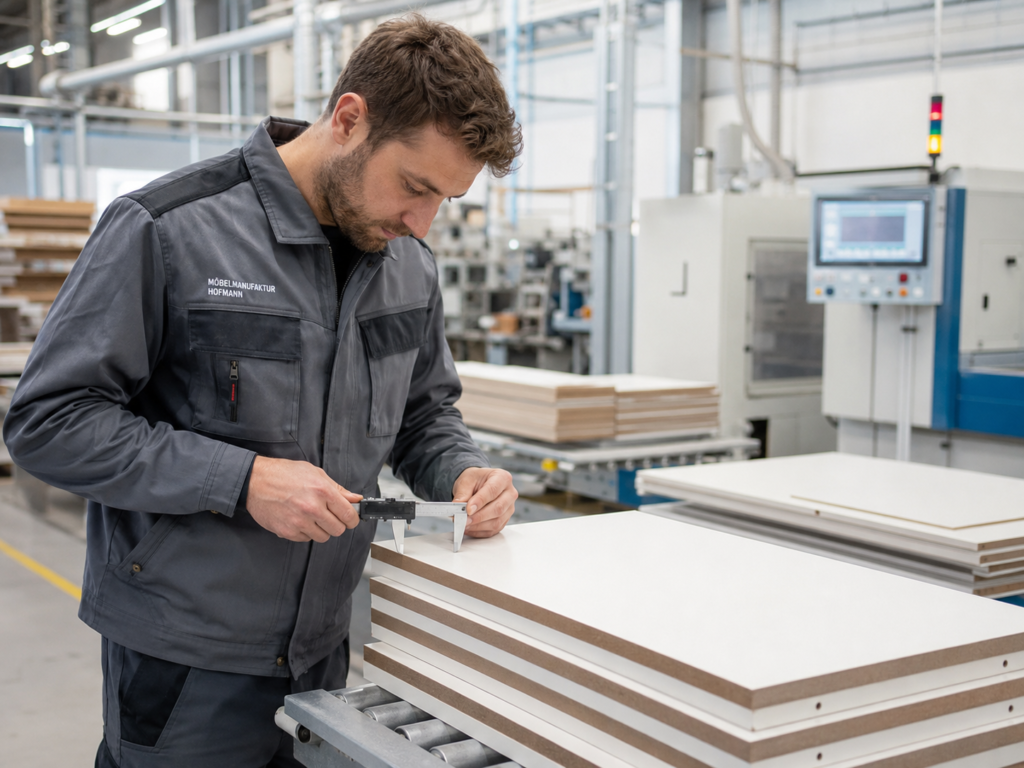
What should you test before buying an edge banding machine?
A quotation can tell you machine specifications.
It cannot tell you whether the machine fits your production.
Before purchasing, prepare real production samples.
A proper test should include:
1. Your actual panel material
Do not test only with supplier-selected samples.
Use:
- your MDF
- your plywood
- your particle board
2. Your real edge tape
Different materials behave differently:
- بولي فينيل كلوريد
- نظام ABS
- veneer
- acrylic
3. Your most difficult parts
Do not only test easy straight panels.
Include:
- narrow parts
- curved panels
- thick edge tape
- visible cabinet doors
4. Final inspection criteria
Check:
Edge bonding
Is the tape firmly attached after cooling?
Glue line appearance
Is the glue line acceptable for visible cabinet surfaces?
Trimming quality
Are there:
- chips?
- uneven corners?
- leftover material?
Continuous production stability
A machine that performs well on one sample may behave differently after hundreds of panels.
A useful quality reference is the AWMAC GIS Policy and Procedures document, which emphasizes inspection procedures and comparing finished work against approved samples.
The same principle applies when purchasing woodworking equipment:
Test the result, not only the machine.
What mistakes do cabinet manufacturers make when choosing an edge bander?
Choosing only by machine speed
A higher speed number does not automatically increase factory output.
If your:
- منشار لوحي
- CNC drilling machine
- workers
- material handling
cannot keep up, the edge bander will spend time waiting.
Buying automation before understanding production
A small workshop processing unique furniture pieces every day may not benefit from a fully automatic production line.
The machine should match the workflow.
Ignoring future product changes
A cabinet factory may start with straight panels but later receive:
- curved furniture orders
- premium kitchen projects
- custom designs
A slightly more flexible machine may avoid another investment later.
Forgetting dust collection requirements
Woodworking dust affects:
- machine cleanliness
- operator environment
- maintenance frequency
Edge Banding Machine Buying Checklist for Cabinet Manufacturers
Before requesting a quotation, prepare this information:
| غرض | Your Requirement |
|---|---|
| Main products | Kitchen cabinets / furniture / doors |
| Panel materials | MDF / plywood / particle board |
| سمك اللوحة | mm |
| Edge tape type | PVC / ABS / veneer |
| Edge tape thickness | mm |
| Daily production | Panels per day |
| Panel shape | Straight / curved / beveled |
| Glue requirement | EVA / PUR |
| Required functions | Trimming / scraping / polishing |
| Factory space | Available installation area |
Choosing the Right Machine for Your Cabinet Production
The right edge banding machine for cabinet production is not determined by the largest motor, highest speed, or longest list of functions.
It is determined by whether the machine fits your actual production.
A small workshop may need flexibility.
A custom furniture manufacturer may need curved processing capability.
A cabinet factory producing thousands of identical panels may need automation and stable throughput.
التعليمات
What is the best edge banding machine for a small cabinet shop?
A compact or semi automatic edge banding machine is usually suitable for small cabinet shops because it offers flexibility and requires less space. The right choice depends on panel shape and daily output.
Is an automatic edge banding machine worth buying?
It is worth considering when your factory produces many similar panels every day. Automation creates more value when repeated manual operations become a production bottleneck.
Do MDF cabinets need pre-milling before edge banding?
Not always. However, pre-milling is useful when panel edges have chips, uneven surfaces, or cutting marks that affect glue bonding and appearance.
Is PUR better than EVA for edge banding?
PUR provides stronger moisture-resistant bonding, but it also requires better process control. EVA remains suitable for many standard furniture applications.
Can one edge banding machine process curved and straight panels?
Some machines can handle both, but many automatic straight-line machines are designed mainly for straight panels. Curved furniture production requires specific machine structures.
What information should I provide when asking for an edge banding machine quotation?
Provide your panel material, size range, edge tape type, production volume, required finish, and any curved or special-shaped components.